
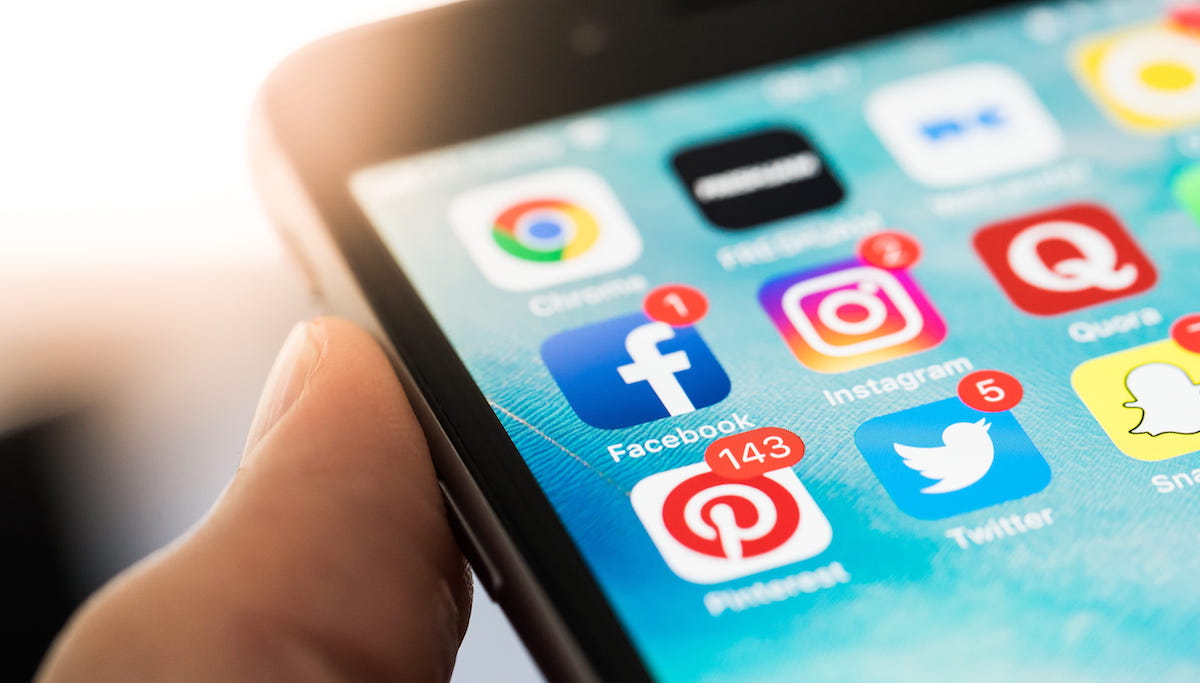
You’re 13 years old. The teacher says you’re going on a two-week break. Something about a virus in China. Something about masks and “social distancing,” whatever that means. Two weeks turn into a month. A month turns into the rest of the school year. The summer passes, excruciatingly slowly, and you still can’t go back to class. And what were you doing this whole time? How did you pass the never-ending hours? Screens. The only tool that has the mind-numbing capabilities needed to make the year go by as painlessly as possible.
Fast-forward a few years. You’re now 16 years old, in high school, and trying your best to stay on top of school, friendships, and extracurriculars. The ever-present phone, however, is still the predominant actor in your life. You gave it the keys to the kingdom during COVID, but unlike Cincinnatus or George Washington, it didn’t give up its emergency power. Boredom remains for you the first and only evil.
This story, although common to millions of my American peers, is my own. I don’t know what made me decide on a change, to break the habit, but I expect many others had similar realizations. Making the decision, however, was only the first step on a long road of reconquest. I’ve spent years in an uphill battle against my screen time, losing just as often as I’ve won.
It is almost universally acknowledged among Gen Z that we are incessantly consuming online “content,” but the solution is hotly debated. One of the predominant sentiments expressed in social media has been a top-down reaction: Shut the platforms down! Restrict them to oblivion! Make them pay! Unfortunately, my peers fail to realize that this is neither a new nor an effective strategy. Litigation and legislation have dominated the proposed solution for almost as long as this technology has existed; suffice it to say, it has produced extremely limited success in reducing screen time. I mean to argue that the government is not the entity to solve our screen problems; addiction is more often displaced than eliminated. Accordingly, not only are band-aid bans unable to meaningfully help us, but I’m convinced that the most effective solutions are those that do not rely on government involvement.
The first mistake in my screen-time reconquista reflected current sentiment. I thought that simple removal of the worst offender was going to solve my problem, but I was wrong. Though my games were deleted, Instagram was gone, and every distraction successively restricted, somehow my screen time remained stubbornly unreduced. I still wasted time on screens, but it was on increasingly ridiculous apps. You normally wouldn’t think of YouTube Music as a time-sucking preoccupation, but it became one. It wasn’t until I replaced the screens with healthier habits that I more effectively extricated myself.
So I picked up the guitar. I read books. I developed real hobbies. The upshot here is this: An addictive appetite is generic and can be satisfied by a variety of suppliers. This pattern is seen in the literature on both substance and behavioral addictions, where drug addicts often substitute other substances when in treatment for (or removal from) a particular drug. This also played out at a large scale in India, where TikTok was banned in 2020; while the platform itself is gone, the population is simply filling the gap with Instagram Reels.
From this principle it’s clear that even if Meta were effectively removed from the market, one should expect other platforms to rise and take its place. So many good and bad actors compete for our attention that it’s foolish to remove one, even a BIG one, and expect everything to go back to the way things were.
One might disagree, saying that banning a company and banning a mechanism are not the same thing. The government should just ban infinite algorithmic feeds, like New York’s soon-to-be-implemented approach in its SAFE for Kids Act. The proposed law will force a chronological, non-algorithmic replacement for minors. This distinction, although legitimate, still doesn’t overcome the age-verification problem. The government has consistently struggled to effectively legislate minor-age identification. Examples include Australia’s under-16 social media ban. When the teens were surveyed, BMJ Group found no meaningful usage difference between 15-year-olds (banned) and 16-year-olds (unbanned). Their workarounds have ranged from using fake accounts, to using parents’ IDs, and even to fake mustaches for passing selfie checkpoints. This failure is a feature, not a bug, of government restrictions on this kind of lifestyle choice.
The only way to effectively restrain teens from accessing these kinds of addictive algorithms would be to impose rules that would hurt platforms that support both legitimate social interaction and other useful digital functions. New York’s SAFE for Kids Act cannot distinguish between recommending a calculus tutorial and “brainrot”; to remove brainrot would be to ban algorithms.
Moreover, this legislation would present additional tradeoffs: When a teen easily circumvents the age gate, he also removes any preexisting algorithmic guardrails, which in turn puts him in danger of accessing material that assumes a certain level of adult agency. Under such a system, the status quo, which modifies the available content based on age self-reporting on platforms like Reddit and Discord, is far preferable to giving a teen unlimited access to the Internet in all its terrible glory.
So we can play victim, blame the Man, and rage against the machine (or machine-learning as the case may be), or we can accept that the tech world now has the spectacular ability to capture our time and attention. What would happen if Meta were litigated into oblivion? Or if it were forced to redesign its algorithm? We would still be embedded in a digital environment, completely dependent on the dopamine rush of watching Reddit stories overlaying ASMR soap cutting or Subway Surfer clips. Centralized intervention like whack-a-mole bans or injunctive relief don’t change the fact that we’ll remain as addicted as ever—if we’re still on the screens, we’ll find a never-ending fount of distractions until we’ve been directed positively to replacements.
Given all this, I do not mean to minimize the harm done by or the seriousness of this issue; a recent report confirms that Gen Z consumes ludicrous quantities of screen time, a high percentage of which is in the form of social media. Nevertheless, the government is not going to solve this problem for us. Meta, putting aside whether the executives had good or evil intentions, has already opened Pandora’s Box of attention-capturing techniques. It may seem that the government should try to shut that particular box, but there is a real danger of relying on the government instead of grassroots social action.
When people believe an external actor has addressed a risk, they will measurably reduce their own efforts at self-protection. This is demonstrated in well-documented patterns like charitable crowd-out in economics and in thePeltzman effect in safety research. Although this unintended consequence doesn’t mean there are no benefits to be had by some regulation, it does suggest that legislation will degrade social and individual change. The solution, the path to herd immunity (as I see it), involves two strategies: collective action and individual replacement.
By collective action, I mean that the march from the virtual to the flesh-and-blood world will happen at least two abreast. The principle of subsidiarity maintains that the person or group closest to a problem ought to address it. So if an individual cannot solve his screen problem, the next step should be to try with two or three individuals—not the DOJ. It works. Find people that either aren’t addicted or want desperately to escape. Join forces, keep each other accountable, and you’ll come out the other side. Wait Until 8th, an organization that helps parents collectively delay smartphone adoption, has seen wonderful results. By removing the social penalty behind screen limitation, it allows kids to just be kids. Find a friend and breaking the habit gets much easier.
By individual replacement, I mean the positive actions one replaces the doomscrolling with. Habit Reversal Therapy (HRT), according to a 2019 meta-analysis, utilizes a similar replacement strategy and is considered highly effective in treating habit disorders. Although HRT was developed to treat tics and compulsive disorders, the core treatment mechanism remains the same: replace a habitual destructive behavior with a healthy one. I picked up a guitar. I read a book. Find something that, after a long session, leaves you satisfied.
This is not by any means an easy fix. It is an unfortunate reality that these online algorithms and systems exist; I am among the approximately 40% of my peers who would eradicate these social media platforms given the chance. But we work with what we have, and with what actually works.









![WHAT POLICY? Crockett Trips Through MS NOW Softball Question on Her Agenda if Elected to Senate [WATCH]](https://teamredvictory.com/wp-content/uploads/2025/12/WHAT-POLICY-Crockett-Trips-Through-MS-NOW-Softball-Question-on-350x250.png)