Magnifica humanitas, Pope Leo XIV’s inaugural encyclical, is largely understood by the public as addressing artificial intelligence. The general public’s view is that, like his namesake 135 years ago in Rerum Novarum, Pope Prevost intends to address the “new things” of the 21st century.
To quote Abraham Lincoln: “There is some truth in this. . .” But to continue his quotation, “. . .I am glad of it, but it is not WHOLLY true.” (emphasis in original)
There are even those who want to spin Magnifica humanitas as a papal abandonment of “pelvic theology” in favor of “social justice.”
There is far less truth in that.
While the pope sought to address “new things,” good stewards know how to bring out of the Church’s storehouse “things old and new.” (Matthew 13:52) Yes, we need to address “new things.” But we address them with the wisdom of old.
What is a more central point to Magnifica humanitas, however, is a more central anthropological truth: the human person cannot be replaced. The human person is non-substitutable. As Vatican II reminded us, the human person is the one creature on earth that God wanted for itself. (Gaudium et spes, 24)
The challenge artificial intelligence poses, on the practical level, is the likelihood of causing human unemployment by the technologization of work, especially basic work often branded as “entry-level.” That especially threatens vulnerable populations: the young, trying to break into the job market; the inexperienced; and the untrained. If, a decade ago, a certain smugness told miners to “learn to code,” today’s hubristic reply might be “polish your barista skills.”
Employment and unemployment are not just economic phenomena because work (as Pope John Paul II noted 45 years ago in Laborem exercens) is not just a cost factor. Employment is essential to human flourishing (which is a bigger and more important category than even economic prosperity, though they are not exclusive).
People need to work. A society that deprives people of work – in the name of a utopian vision or to maximize profits – is an inhuman society. And let’s not allow some people to get away with downplaying that truth because they won’t admit what they want is a society driven purely by economics. As in the old adage, these are folks who know the price of everything but the value of nothing.
AI also poses a theoretical challenge. Ever since Plato – and especially since Descartes – there’s been a temptation to think of the human person as a mind merely inhabiting a body. Contemporary transhumanism simply radicalizes that mistake by imagining consciousness detached from embodiment.

Christian anthropology insists instead that the human person is an embodied unity whose dignity cannot be reduced to information or computation. (Of course, according to certain early theologians, it was precisely that incarnational state that provoked diabolical rebellion). That some “transhumanists” have visions of minds detached from bodies dancing in their heads suggests that the theoretical threat continues.
The core problem is not technology: it’s humanity.
Oren Cass captured this problem in his reflections on the common social-event question, “What do you do?” It typically functions, Cass observes, to pigeonhole people: doing X gets you special creds, doing Y is meh (except when the specially credentialled need food deliveries, plumbing repairs, or electrical work).
Very few ask the question from the standpoint of the Christian anthropological value of work, i.e., what does who you are find expression in what you do?
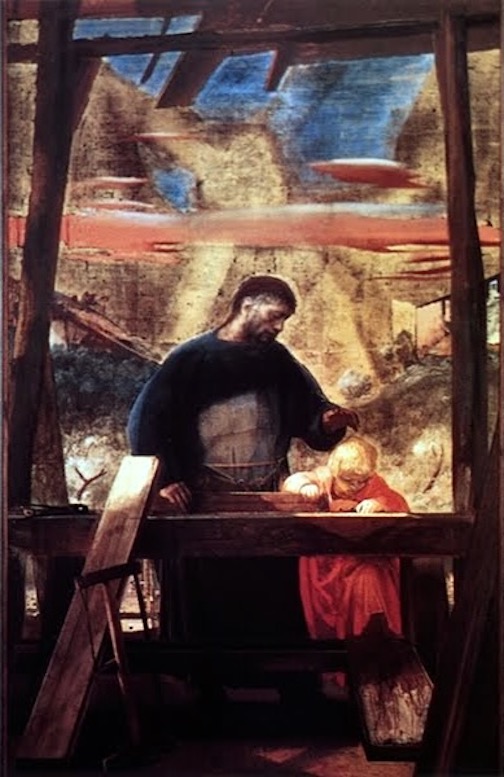
A crucial truth of Magnifica humanitas is the centrality and irreplaceability of the human person. Man is not just a thinker that a machine can replace. Man is not just a worker that a robot should replace. The encyclical asks the question: do you think that a person’s qualitative distinction trumps his potential functional technological-economic substitutability? Is a person more than just a cog in somebody’s grand design?
Because he is not a cog in God’s design. Yes, God created him and even gave him work to do, not as a punishment for sin, but because it was essential to his nature and role as God’s image and likeness. Man’s place in God’s universe is one of a free, loving person invited to participation in free and eternal love with Three Loving Persons. That’s the message of salvation. It’s fundamentally different from man as divine widget.
To the degree that Magnifica humanitas illustrates how AI might imperil that truth, it reveals a perspective on a bigger question that the pope answers from a Christian perspective: who is man? But that question is implicated not just by AI. It is at stake in the “Pill” mindset, reflected in the contraceptives of the 1960s and the abortifacients mifepristone and misoprostol today. That stance imagines that human problems and the consequences of human choices can be solved by some “Pill.” It finds echoes in the drug and alcohol subcultures, which imagine that human happiness can, temporarily, be chemically induced.
It is implicated in what South African Archbishop Denis Hurley once called the “technological imperative” and writer Walker Percy “technophilia” – the idea that if we can do something, we may, perhaps even should. And nobody can put the genie back in the bottle once somebody crosses a technological Rubicon.
It’s the mindset that believes that fertilizing ova in test tubes is just another way of making babies, a “process,” perhaps even better in terms of “quality control” than the old-fashioned way. Is conjugal love just another “process?”
Which is why, pace the David Gibsons of the world, Magnifica humanitas is not a binary choice – much less a split – between “pelvic theology” and “social justice.” Social justice starts in the womb: how a child gets there and whether he or she is protected once there. Yes, that child should one day have the chance to work. But that right presupposes the prior chance to live. God didn’t make man in his image and likeness just to work: He made him above all to be.



![Hegseth Demands Fitness Requirements, Says 'Fat Troops' 'Not Who We Are' [WATCH]](https://teamredvictory.com/wp-content/uploads/2025/09/Hegseth-Demands-Fitness-Requirements-Says-Fat-Troops-Not-Who-We-350x250.jpg)