As everyone knows by now, the ordination of bishops carried out by the Society of St. Pius X (SSPX) has resulted in the automatic excommunication of the six bishops involved. No matter how it may spin its canonical status, the Society is now definitively outside of the Catholic Church.
Insofar as the SSPX denies the authenticity of Vatican II, this outcome was inevitable. After all, Pope Leo himself has been uniting the Church around the Council, devoting his weekly audiences to examining, and profusely praising, conciliar teaching.
One cannot cogently argue, as the SSPX does, that Vatican II was not a legitimate council. (Subsequent developments, of course, can be debated, and are – within the Church.) In fact, the great synod bears every mark of an authentic ecumenical council of the Catholic Church. What are these marks?
• The Council was formally convoked by the bishop of Rome, John XXIII.
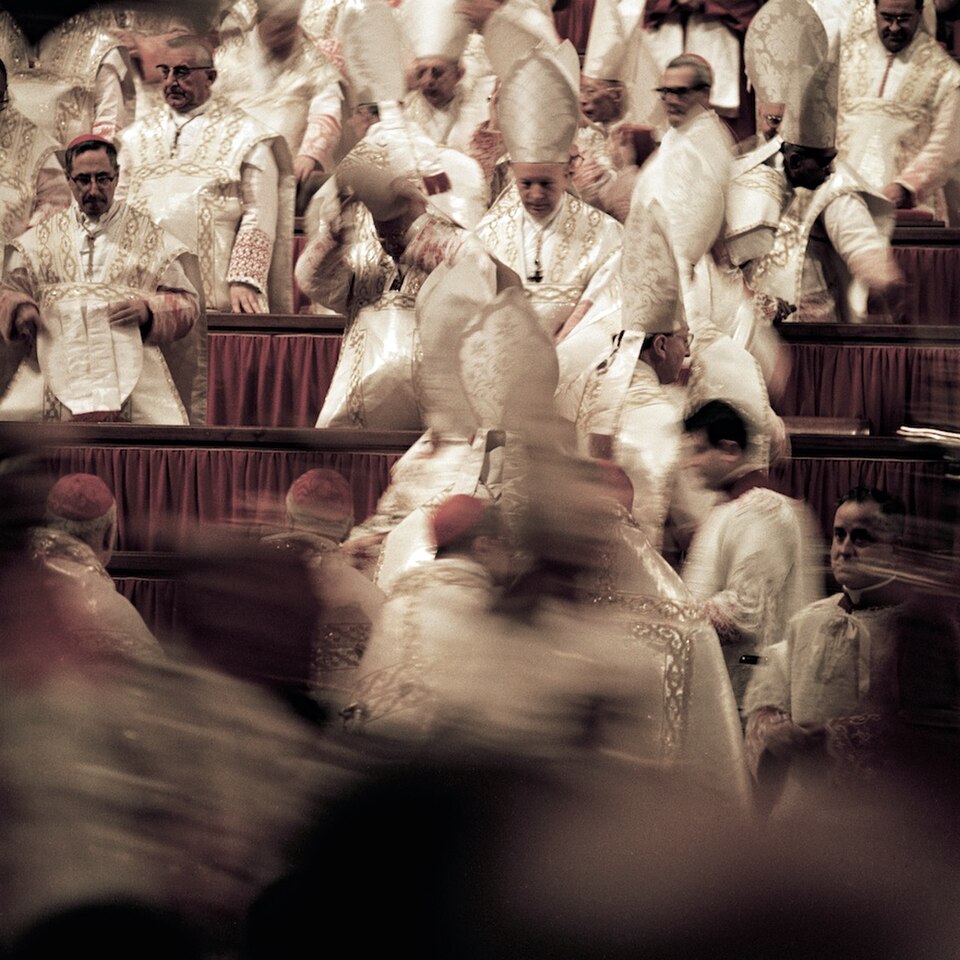
• Ahuge number of bishops, over 2,500 from the entire world, was gathered at the Council for debate and deliberation from 1962-1965.
• All bishops could speak freely or, if desired, submit written comments (which were then carefully examined by the Theological Commission).
• The Theological Commission (where the conciliar documents were drafted or reviewed) was composed of a mixture of more conservative and more progressive bishops and theologians. A review of their journals reveals that even the smallest points were debated freely and at great length.
• Anyone who studies the texts of Vatican II will see the extraordinary care and balance achieved by the documents – which underwent numerous drafts before final voting.
• Paul VI always insisted that the concerns of the (more conservative) minority be adequately addressed. To cite only two examples: At the last minute, Paul mandated nineteen changes to the Decree on Ecumenism (Unitatis Redintegratio) in order to satisfy those bishops who wanted a stronger accent on the truth mediated by Sacred Tradition. Secondly, Paul insisted on the Nota Explicativa Praevia appended to the Dogmatic Constitution on the Church (Lumen Gentium). This interpretative note was added to ensure, in juridical-canonical language, that papal primacy was in no way jeopardized by episcopal collegiality.
• Each one of the sixteen conciliar documents was approved by an overwhelming majority vote.
• Each of the documents was formally promulgated by the Bishop of Rome, Paul VI.
In truth, one could more easily marshal questions about the First Vatican Council, held in 1869-1870. At that council, episcopal speakers were occasionally shouted down, and some seventy bishops left Rome so as not to vote “non placet” on the infallibility of the papal magisterium.
The argument against the legitimacy of Vatican II, made by the founder of the SSPX, Archbishop Marcel Lefebvre, is straightforward. He and his movement contend that the most recent council fulfilled the long-standing dream of liberal Catholicism: marrying the Church with the French Revolution.

The Council allegedly betrayed the ancient Catholic faith by incorporating the three chief principles of the revolution of 1789: liberté, égalité and fraternité. The conciliar declaration on religious freedom (Dignitatis Humanae) is little more than the “liberty” of the revolution – leading inexorably to indifferentism in religious matters, thereby undermining Catholic truth.
And in promoting episcopal collegiality, Lumen Gentium made common cause with the revolutionary notion of “equality,” speaking as if all bishops were equals, thereby corroding papal authority and primacy in the process.
And the revolutionary “fraternity” may be found most clearly in the Decree on Ecumenism, wherein the SSPX argues that contemptible heretics are now facilely called “separated brethren.”
Also central to the SSPX argument is a statement by Yves Congar, one of the important theological experts at Vatican II. In October 1963, the Council took several votes in order to orient the work of those composing Lumen Gentium. The votes overwhelmingly endorsed the importance of episcopal collegiality.
Of these votes, Congar wrote in his daybook: “The Church has undergone peacefully her October revolution.” This was perhaps not the happiest phrase, but was intended to indicate that, after a long period with an autocratic papacy, the college of bishops had reclaimed their supreme authority in the governance of the Church – although, as the Dogmatic Constitution states, this authority must always be exercised “together with its head the Roman Pontiff and never without this head.”
Congar hardly intended, as the SSPX argues, to compare Vatican II to the Bolshevik Revolution. On the contrary, Lumen Gentium is in fundamental continuity with earlier Church teaching, clearly preserving papal primacy even while upholding the apostolic authority of the episcopal college.
A chiaroscuro effect accompanies every conciliar teaching – and so it has always been. Some teachings that are emphasized will necessarily leave others in the shadows. And teachings that had been in the shadows are, at times, newly highlighted.
At Vatican II, episcopal collegiality balanced Vatican I’s prior accent on papal authority. And the most recent council’s accent on the universal priesthood of the faithful was intended to balance Trent’s legitimate accent on the ministerial priesthood.
One can certainly claim that some emphases of Vatican II need further balance. But there is a world of difference between seeking greater balance and rejecting the authentic teachings of an ecumenical council.
Vatican II was an extraordinarily fruitful synod, with considerable advances in ecumenism, inter-religious dialogue, and religious freedom. To use the language of the fifth-century theologian St. Vincent of Lérins, the conciliar documents allowed a true advance of the faith (profectus fidei), not an alteration of the faith (permutatio fidei).
In truth, there is no solid theological ground whatsoever on which the SSPX can stand. They have sown the wind and now reap the whirlwind.