This is the first summer in quite a while that circumstances have prevented me from taking a walking pilgrimage, usually something like the Camino de Compostela (here) or the Via Francigena (which nearly killed me a few years ago between the heat and distance (here). My favorite, however, is still St. Cuthbert’s Way, which runs from Melrose in Scotland over the mountains on the border with England and down to the Holy Island of Lindisfarne (here).
I’m deeply convinced that a walking pilgrimage – in its combination of the spiritual and the physical on God’s green earth– is of far greater human and religious value than anything we’ve yet seen in the interminably bureaucratic synodal “walking together”(here).
But it must be a real pilgrimage, and there are disturbing signs that many people are now turning even some of the most hallowed pilgrim routes, followed by great saints and penitent sinners over centuries, into just one more self-involved path to “personal fulfillment.” There are even pilgrimage “influencers.” And those who enter classic pathways in search of “wellness.” (Mercy, Lord.)
To be clear: a pilgrimage doesn’t have to be a perfect ascetic or soulful exercise. Or a perfect anything. Even in the Middle Ages, Chaucer (realistically) included the lusty Wife of Bath and tipsy Miller in The Canterbury Tales, his poetic account of a group of pilgrims – sinners as are we all – on the way to the shrine of the great martyr St. Thomas Becket.
Anyone who makes a walking pilgrimage even today will find that there are days of drudgery and distraction amid others of lightness and purpose. Sometimes even a single day will take you through many combinations and permutations of highs and lows. In all that, the walking is like life more generally – with the difference that you’ve chosen, if you’ve chosen wisely, to pursue a particular path to a definite end. Which is not normally something you do every day. And if you’re also lucky, it will make other paths clearer and more bearable.
There is a kind of “personal fulfillment” in all this, but it’s a fulfillment that results from being less focused on yourself and more focused on the Way. I think that this is one reason why the early Christians were often described as followers of ἡ ὁδός (hē hodós) “the Way” (Acts 9:2, etc.). That Way would be the Very One who told us He was the Way, the Truth, and the Life.
It’s worth reflecting on that historical fact. Later, of course, maybe within a decade after the Crucifixion, the name changed: “the disciples were called Christians first in Antioch.” (Acts 11:26) Which seems to suggest that it was, at least initially, as important to walk the walk as to talk the talk.
As the disciples on the way to Emmaus and St. Paul on the way to Damascus found out, some earth-shaking things can happen when you leave the familiar and are “on the way.”
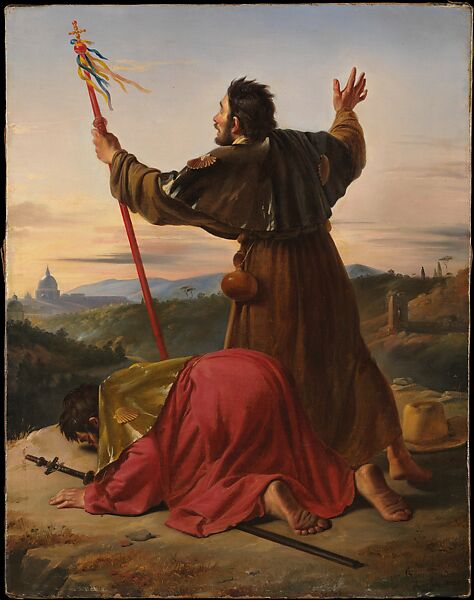
The apostles travelled far, mostly on foot – Paul, of course, all over the Eastern Mediterranean; Peter to various places and, with Paul, eventually to Rome; James, maybe (according to later records) to Spain and then back to martyrdom in Jerusalem; Andrew to Russia; Philip to Turkey; Matthew to Ethiopia; Thomas to India, etc.
Where and how they died in several cases are now, like many ancient things, rendered somewhat uncertain in the mists of time. But we can be certain that they all took seriously Jesus’ great command to preach the Gospel to all nations. Which is why their graves, too, have themselves become places of pilgrimage.
There’s something bracing about getting up in the morning and, instead of following your usual routine or jumping into the car, instead tying on your walking shoes and heading off on you know not what.
I have friends and family who like what’s predictable and balk at the idea of taking off on unknown paths. I – sort of – get that. It’s good and necessary to have a certain amount of predictability in your days. But it’s also an illusion. Even if you’re sitting at home today (which may not be so bad an idea given the current heat wave), you don’t really know what will happen along the way or where you’ll be by evening.
It’s a cliché, which is to say it’s a known and tested truth that ought to be dusted off and re-appropriated, but life is a pilgrimage whether you know it or not. Not to know that is to consign yourself to the road not taken.
Let me beg the indulgence of TCT readers and direct you, yet again, to the words of the sommo poeta, Dante Alighieri, in the Inferno. Because he’s given us such a vivid summation of so many truths about the Christian life.
As you know, or should if you do yourself the favor of turning or returning to the first pages of that greatest of poems, Dante himself (the pilgrim in the story) hesitates before starting on the way. I’m not Paul or Aeneas, he says (both visited the other world while still alive in this one), not on a level with the great Apostle to the Gentiles or the mythical founder of Rome.
But in fact, as the first lines of the poem make clear, it’s precisely because the verace via era smarrita – “the true way has been lost” – that we all have to put ourselves on the right way again. Not to do so, we soon learn, is to join a pitiful band of people who are not even worthy of condemnation but wander in their chosen pointlessness:
The world will let no fame of theirs endure;
both justice and compassion must disdain them;
let us not talk of them, but look and pass.(Inf. III)
So however you manage to do it, dear reader, flee, today, this worst of all fates. It’s summer, but walk towards the light whatever way you can. Shun the way not taken. Walk truly.