Americans don’t suffer from amnesia. We prefer it. Memory shapes who we are as individuals, a nation, and a culture. But we define ourselves as a “new order of ages.” Those words are stamped directly on America’s Great Seal. Thus, Americans dislike the past. And since the 1960s, Europeans have followed suit. The reason is simple. History as it really happened is inconvenient baggage. We ignore or reinvent it, the better to reinvent ourselves. And this is exactly how the modern spirit (see here and here) treats our civilization’s Christian roots.
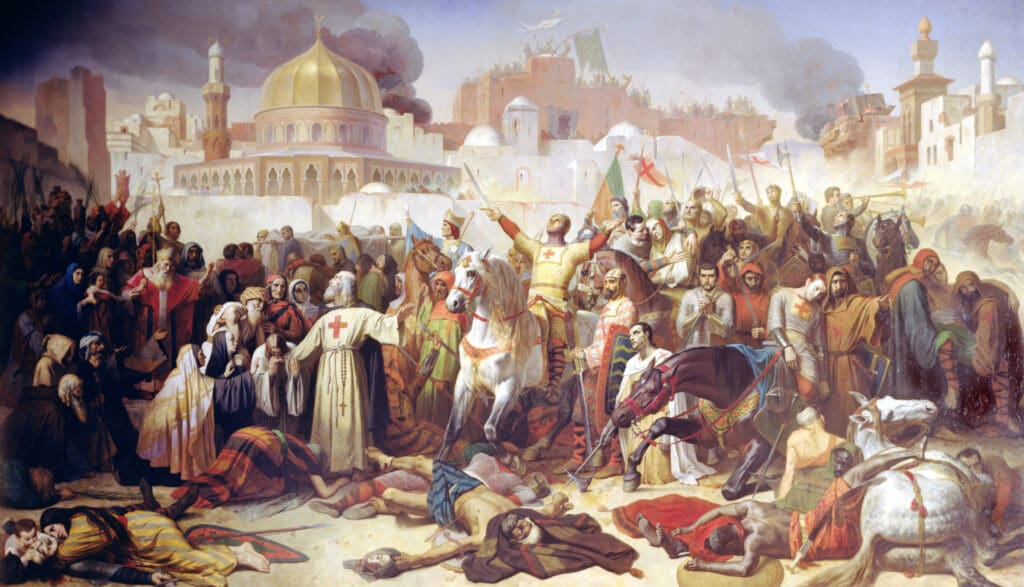
The term “Middle Ages,” for example, is a creature of Renaissance humanists. The Enlightenment added a bitter flavor to the mix. For men like Voltaire, the Christian past was little more than a blend of cruelty, ignorance, and superstition. And that caricature – that perversion of real history – persists today. Robert Eggers’ upcoming film Werwulf, releasing on Christmas Day 2026, features a predictably wicked priest in a ferociously bleak 13th century. Ridley Scott’s 2005 film Kingdom of Heaven showcases 12th-century corrupt Christian clergy and psychotic crusaders quacking “God wills it!” in pursuit of mayhem.
The trouble with caricatures is that they’re false. They’re a cocktail of fact and self-serving modern revisionism. The “Middle” Ages had plenty of disease, poverty, violence, and disorder. But they were also marked by extraordinary art, architecture, and scholarship. They also saw a profound religious renewal; a flowering of civil, canon, and common law; and a striking economic revival. As for the Crusades – that favorite target of modern critics – consider the following.
Jonathan Riley-Smith (d. 2016) is revered as one of the great historians of the last 100 years. He’s also widely seen as the premier scholar of the crusading era, a reputation built on a massive body of work. A convert to the Catholic faith in his Cambridge undergraduate years, he never diminished or romanticized the violence of the Crusades. Quite the opposite. He noted that they were often undermined by “indiscipline and atrocities” – including fierce outbursts of hatred against Jews – with immense suffering as a result. But he explained their context and content with exceptional accuracy. And he insisted on seeking to understand the Crusades through the eyes of their participants.
Riley-Smith’s book The Crusades, Christianity, and Islam, based on his 2007 Bampton Lectures at Columbia University, captures in barely 80 pages the realities of crusader motives, life, and times. He has special disgust for modern distortions like Kingdom of Heaven, in which:
a cruel, avaricious, and cowardly Christian clergy preaches unadulterated hatred against the Muslims. The priests’ stupidity and fanaticism are echoed in the minds of the crusaders, the Templars, and most of the leaders of the Christian settlement around Jerusalem. . . . [Yet in] the midst of zealotry and bigotry a brotherhood of freethinkers has vowed to create an environment in which all religions can coexist in harmony. They are in touch with [the Muslim leader] Saladin, who shares their aims of toleration and peace, but zealots on the Christian side set out to wreck any chance of an accommodation with Islam.
For today’s secular skeptic or the uninformed moviegoer, such a storyline might have value as entertainment. But as history, it’s sheer counterfactual propaganda.

As incomprehensible they might seem to the present-day mind, the Crusades were “collective acts of penance,” “penitential war pilgrimages” and — most importantly — fundamentally reactive to Muslim conquest of the Holy Land and interference with Christian pilgrims. They emerged from an organic medieval theology of penitential warfare and Augustinian just-war thinking, not a perversion of it. As Riley-Smith notes, they had the support of saints from Bernard of Clairvaux to Thomas Aquinas to Catherine of Siena. The Crusades were never colonialist or imperialist in a modern sense.
They also involved great risk: Crusading had a death rate of around 35 percent among nobles and knights, with much higher casualties among the less well-off. Nor did they result in great wealth. The Crusades were financially ruinous for the vast majority of those who took part. And the claim that crusading provided a way to offload onto the Levant the younger sons of European nobility – sons who were unable to inherit their families’ lands and titles – is also false. Among the nobility, crusading was often a family affair. Fathers and sons left and fought together. And most surviving crusaders returned to Europe once a crusade had succeeded or failed, often in debt and with broken health.
Simply put, despite the many and serious sins of crusaders, the primary crusading motives were genuine religious piety and zeal — something modern elites neither understand nor respect. Christians of the crusading era saw Islam as a persecutor of the faithful, a desecrator of the holy places, and a brutal aggressor that had seized Jerusalem, Spain, and much of the (Christian) Byzantine Empire by force in the name of jihad; strangled Christianity across North Africa; and driven deep into France before being pushed back. Today we can criticize and regret the concept of “holy” wars. But we do it from a very convenient distance.
So what’s the point of dredging all this up?
In George Orwell’s dystopian novel 1984, the regime’s Ministry of Truth works ceaselessly to ensure its infallible grip on reality. Troublesome news, photos, and facts from the past are simply revised or vaporized in “memory holes” that erase them. Here in our own time and country, we do nothing so blunt; nothing so vulgar. Instead, we simply forget. We make the past and its obligations irrelevant – forgettable flotsam on a river of noise and comforts; distractions and addictions to the new. As FanDuel Casino endlessly reminds us, we’re all potential “thrillionaires.”
Here’s the problem: An important Someone once said, “Do this in memory of me.” (Luke 22:19) Remembering God’s Son, who we are as his people, our pilgrimage through history, and our missionary vocation: Such is our mandate and glory. We’re part of something larger and more beautiful than ourselves, our sins, and our times. And the task of remembering that is sacred.


![Hegseth Demands Fitness Requirements, Says 'Fat Troops' 'Not Who We Are' [WATCH]](https://teamredvictory.com/wp-content/uploads/2025/09/Hegseth-Demands-Fitness-Requirements-Says-Fat-Troops-Not-Who-We-350x250.jpg)