
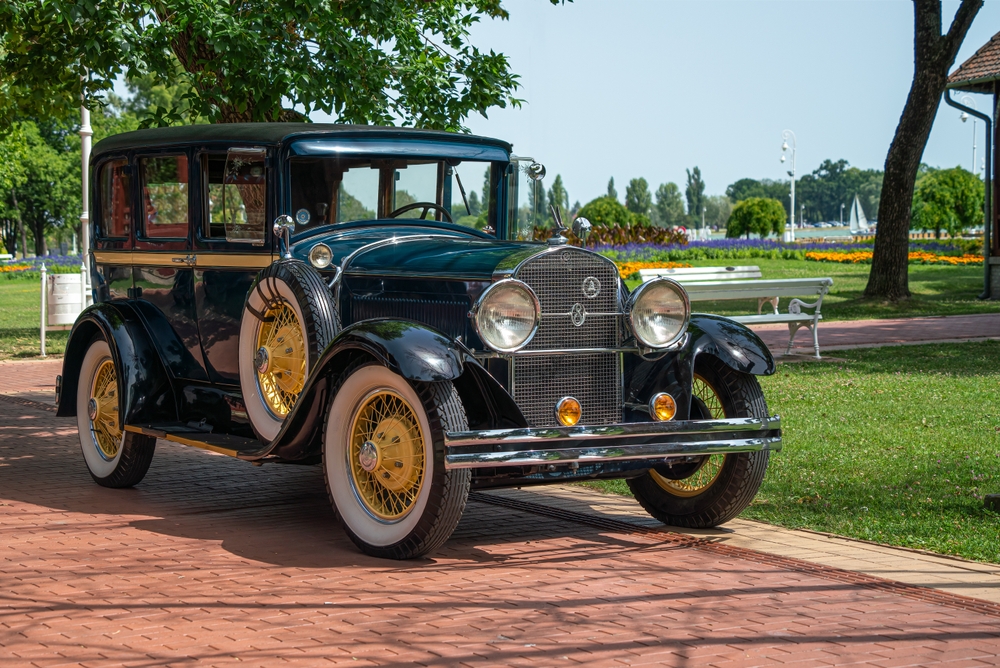
If you want to know when everything in society went to pot, it was with the invention of the automobile. Or so the author of Lord of the Rings would have you believe.
Given J.R.R. Tolkien’s self-evident greatness (and the millions of copies his novels have sold), it is perhaps little surprise that HarperCollins—the house now responsible for publishing his works—continually unearths obscure texts to bring out in new editions. From collections of essays on Middle-earth to volumes of collected poetry, many shed new light on his literary imagination. Yet Tolkien did not write fantasy out of a craven desire to acquire vast wealth but rather to participate in what he called “sub-creation.” One could even argue that the construction of Middle-earth was a kind of worship, the crafting of a “sanctifying myth.” His enthusiasts are right to worry, then, that this trend, at a certain point, may amount to the crass commercialization of the professor’s legacy of words.
Happily, that is not at all the case with the latest title published by HarperCollins, The Bovadium Fragments. A satirical fantasy Tolkien wrote mostly for his own amusement, it pokes fun at the way modern technology remade British country life in the twentieth century. Beautifully edited and printed along with Tolkien’s own striking art depicting Oxfordshire, it is a handsome addition to any bookshelf. But the story is more than that—it’s a warning about the dangers of mechanization we desperately need in the Digital Age.
The main text of The Bovadium Fragments is a farcical re-creation of a medieval manuscript recounting the fall of the titular realm to a machine that Tolkien hated more than almost anything: the motorcar. It begins with an amusing frame narrative, containing much Latin, that pokes fun at academic pretensions of grandeur. Tolkien is celebrated today for what he called his “secret vice” of inventing languages such as Elvish, but he was also an immensely accomplished philologist who spoke or read many real ancient tongues. Much as his constructed languages add a sense of mythological depth to The Lord of the Rings, the use of Latin deepens the humor of The Bovadium Fragments. Throughout the short book, one gets a sense of the Oxford that Tolkien loved—and what was putting it at risk.
The proximate occasion for Tolkien’s satire was the efforts of planners commissioned by Oxford to redesign the local roads to better accommodate traffic. “Bovadium” is a pun on the Latin word for “oxen,” making the parallel quite clear. Tolkien first arrived in the university town as a student in 1911, falling in love with the “dreaming spires” and natural landscapes. Throughout his career as a scholar there, he saw the entire city take on a new character for the sake of these vehicles.
Tolkien hated automobiles because they were noisy and dirty, and he was disturbed by the triumph of speed and mass that they represented. And while others dismissed the deaths of pedestrians and motorists alike as the necessary cost of progress, Tolkien lamented them as truly avoidable tragedies. Heedless innovation was not something he treated with casual disregard. To him, cars were not simply convenient modes of transportation; they were nothing less than an oil-fueled revolution. In this story, he satirizes them as Motores, great hulking monsters of metal that poison the air, destroy the environment, and kill the human beings who have the misfortune of crossing their path. Only too late do the sages of Bovadium realize the danger of letting the Motores remake their way of life.
Tolkien was especially concerned with the way human beings were remaking the physical world to accommodate automobiles. He loved the meadows and valleys of rural England and was utterly distraught by the efforts of central planners to tear them apart with new roads and highways. As Richard Ovenden writes in an essay about the origins of Bovadium, included in this volume, the tale “was good humoured and moderate in tone, though the message is clear—the role of planners in changing the environment in which people lived … was both dangerous and negative.”
Indeed, the residents of Bovadium quickly find that their plans to control the flow of traffic do not solve the issues presented by the Motores. “Nevertheless the constipation of the highways did not mitigate the noise and stench in the city; for if halted the Motores belched the more, while they drummed and throbbed inwardly in thwarted rage,” the narrator tells us. “No longer could any man converse with another in the streets save in hoarse shouts and at the peril of choking in poisonous fumes.” The Motores unalterably change the life of the university town, reducing citizens to isolated individuals and making conversation impossible. In one version of the story (the book includes editorial attempts to “finish the story” for Tolkien), the choking fumes even kill all the residents. In another, the Motores brutally kill any pedestrians who stand in their way. Despite the humorous tone, Bovadium’s fate is anything but happy.
The downfall of Bovadium is that its people ultimately become slaves to the technology they introduced to their bucolic society. “It is true that there were not a few who had ceased to govern their Motores, but had become their servants, finding their chief pleasure in waiting on them,” the story goes. “Such men cared very little what their Motores did, so long as their skins shone and they purred. Indeed on the days formerly set aside for prayers and rites in the temples, many would now wheel their Motores out upon a platform before their houses and there tend them and worship them, prostrate upon the ground.”
In many respects, the residents of Bovadium resemble another tragic figure from Tolkien’s life: Saruman of Many Colors, the secondary antagonist of The Lord of the Rings. Although he belongs to the same order as the wise and heroic Gandalf, the traitorous wizard turns his back on his friends and joins the side of evil because he believes its triumph is inevitable. As one character puts it in The Two Towers, Saruman possesses “a mind of metal and wheels,” obsessed with conquest and convenience. Just as Bovadium’s leaders remake their city for the sake of the Motores, Saruman ruins his home of Isengard and preys on the nearby forest of Fangorn to create for himself an army of orc warriors. In both stories, the destruction of the physical environment symbolizes an inner moral violence we must avoid.
Tolkien’s near-Luddite skepticism can still teach us how to relate to new technologies, even if motorcars have become an insurmountable fact of modern life. The Digital Revolution, from smartphones to artificial intelligence, promises to make human life easier by delegating more and more to our virtual assistants. But this all comes at a steep environmental cost—and an even steeper spiritual price. Tolkien’s fiction warns us that when we disconnect ourselves from nature, from God’s creation, we also lose our sense of self.
All around us, we see signs that modern society is slipping into the kind of technological idolatry that doomed Bovadium. The rage of social media and the near-universal addiction to screens are disheartening, to say the least. As industrialization turns to digitization, it seems our lives get further and further away from the rootedness Tolkien prized. But we do not have to allow our minds, like Saruman, to become subject to “metal and wheels,” or subject our society, like Bovadium, to machinery. In fact, Tolkien’s rediscovered story may even help us laugh at these trends—and remember what it means to be truly human and thereby help us avoid Bovadium’s fate.








![WHAT POLICY? Crockett Trips Through MS NOW Softball Question on Her Agenda if Elected to Senate [WATCH]](https://teamredvictory.com/wp-content/uploads/2025/12/WHAT-POLICY-Crockett-Trips-Through-MS-NOW-Softball-Question-on-350x250.png)