America’s Chrysostom
Michael Pakaluk
St. John of Antioch, called Chrysostom or “golden-mouthed” (d. 407), “is generally considered. . .the greatest preacher ever heard in a Christian pulpit,” according to the Catholic Encyclopedia.
Or are homilies even more golden if they are concise? Nearly all the surviving works of the 5th-century Bishop of Ravenna, Peter, are homilies noteworthy for their conciseness as much as their eloquence. Tradition has it that this Peter received his nickname, “golden-worded,” when the Roman Empress heard him preach and pronounced him “Chrysologus!” Venerated as a saint and later declared a Doctor of the Church, today he is called “Doctor of Homilies.”
Not that golden words are the same as holiness. They ring hollow and appear manipulative, like a cheap clanging cymbal, unless they express sincere devotion. St. Paul sets down the principle: “my speech and my preaching were not in the persuasive words of human wisdom, but in shewing of the Spirit and power; that your faith might not stand on the wisdom of men, but on the power of God.” (1 Corinthians 2:4-5)
Fulton, the 20th-century Bishop of Rochester, New York – to be pronounced Blessed today – understood the point full well. A necessary condition of his preaching was to spend an hour before the Blessed Sacrament in prayer, which he did without fail for over 60 years.
He was a philosopher and theologian first, but also – and this is quite rare – he was an orator, and recognized as a great one, when traditions of oratory were still being passed on, although dying out, within Catholic colleges and universities. He would say that he never spoke from a written text. Persons had to be addressed by persons, not texts. He would quote what an old Irish woman said about a bishop reading his speech: “If he can’t remember it, how does he expect us to?”
In his autobiography, Treasure in Clay, he tells how above all he studied for style G.K. Chesterton – “who never used a useless word, who saw the value of a paradox and avoided what was trite” – but also C.S. Lewis and Malcolm Muggeridge.
After writing his dissertation in Louvain, Belgium, he taught at the seminary of the Westminster archdiocese in England, St. Edmund’s, where Fr. Ronald Knox was his colleague. Perhaps it was Knox who introduced him to Chesterton in 1925. In any case, Chesterton later agreed to write an Introduction for Sheen’s first book, God and Intelligence in Modern Philosophy (1925).
The book is based on Sheen’s Louvain dissertation. But it is very far from a dissertation, or the dissertation was a most unusual one, because it is not written in a flat-academic style, but sparkling with Chestertonianisms and quasi-paradoxes. From the start, Sheen’s words were golden on the page as well as from the pulpit.

Its opening paragraph is a riff on Chesterton’s “Wanted, An Unpractical Man,” from What’s Wrong with the World:
Modern philosophy has seen the birth of a new notion of God. There is nothing of greater importance, as there could be nothing more ultimate. Even the very attitude of one man to another or of one nation to another varies with the conception of God. The outlook on the world changes the moment the outlook on God changes. And if we had intellectual vigour enough to ascend from effects to causes, we would explain political, economical and social phenomena less by credit sheets, balance of trade and reparations, than by our attitude towards God.
The new notion of God is not that of a divinity who is, but of one which becomes. But to accept this notion, Sheen says, is necessarily to accept a changed view of human intelligence. How we understand God and how we understand our own intelligence rise and fall together: “What happens, then, when a philosophy rejects the intellect? It breaks the link between the world and God, denies a hymn of divine praise to the Creator, and knocks the world into an unintelligible pluralism.”
Though it was published in 1925, one cannot find a book more relevant to discussions of “artificial” intelligence today. “What is the purpose of the intellect?” he asks. “Is it the faculty of the divine, the transcender of the contingent, the plaything of the contemplative, or is it merely a primitive tool used crudely by men for want of a better instrument?” This last alternative sums up where we have landed. And now a better instrument is at hand.
Such a world of a redefined God and redefined intelligence must plunge us into an animalistic state, living in a society of “scientific feeding” (as Weaver called it in Ideas Have Consequences):
Only a century ago Rationalism gloried in having liberated the intelligence from extrinsic control. Now it has denied the rights of reason entirely and falls down before the altar of sentiment. In pulling the mitre from intellectual man it has pulled the head off with it. We are no longer men, but animals. We “feel” our way instead of knowing it.
Sheen’s book appeared in the heady days of Neo-Scholasticism – the first “Catholic Moment” of the 20th century – when serious administrators at secular universities supposed that Thomism might offer what was lacking in their hollow institutions. At about the same time that Gilson was invited to lecture at Harvard, Sheen was invited by the president of Columbia to give lectures on Scholasticism; Cardinal Bourne wanted him at Oxford, alongside Knox.
His bishop sent him instead to be curate of a poor parish in Peoria, and only after a year to The Catholic University of America, where by 1929 he was already speaking of “Educating for a Catholic Renaissance.”
That renaissance did not come. Late in life, Sheen told a retreat of priests: “The only argument the world will listen to now is the argument of personal holiness. It has heard all the rest and rejected them.”
Blessed Fulton Sheen, pray for us, that we may play our own part in the renaissance you hoped for, not only by eloquence, but also by the argument of holiness.
__________
An Extraordinary Conversation with Fulton Sheen
Christopher M. Reilly
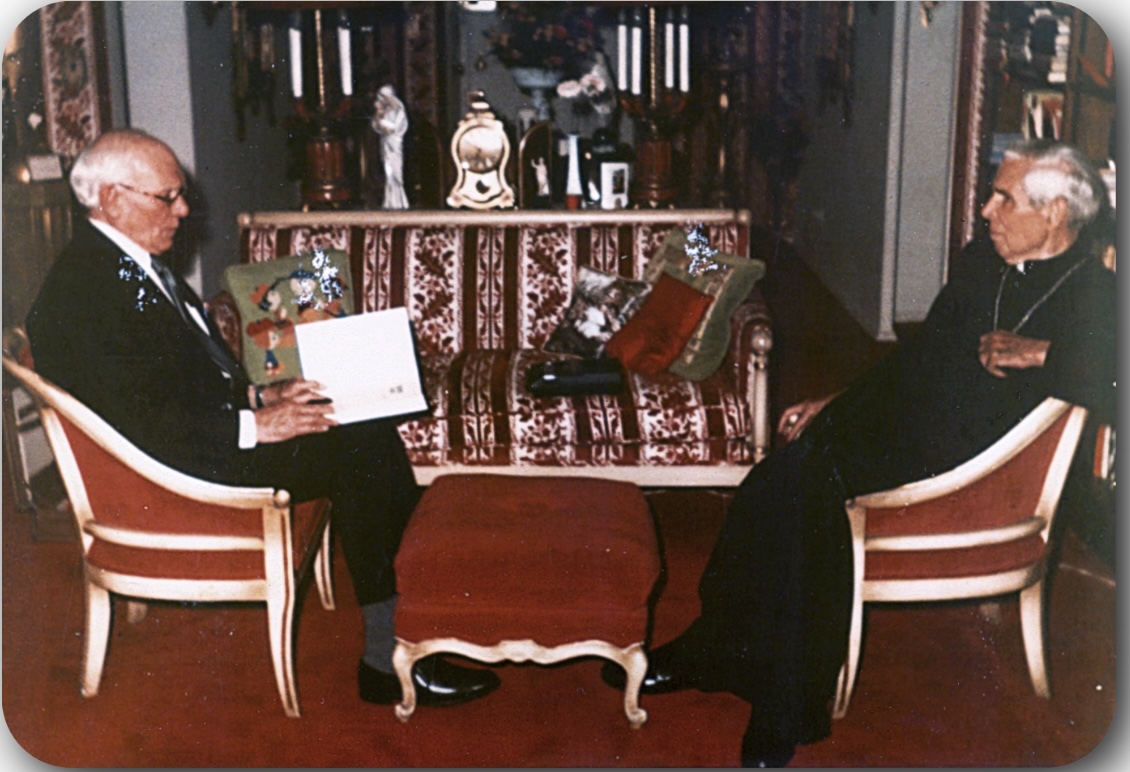
In May 1979, Archbishop Sheen was suffering from the effects of recent open-heart surgery. Sheen still craved social interaction, and he had written a note to James P. McFadden, Associate Publisher of National Review magazine and founder of both the Human Life Review and the National Committee of Catholic Laymen: “you spoke of [celebrated British journalist] Malcolm Muggeridge. There are few men in the world for whom I have higher esteem. . . .I would be honored and delighted and inspired if the both of you could come to visit me at my apartment.”
Malcolm Muggeridge was visiting New York that May, and the entire subsequent conversation between Archbishop Sheen, Muggeridge, and McFadden – a meandering and inspiring journey through such diverse topics as the value of suffering, the poverty of Marxism and the Soviet Union, and praise for Mother Teresa of Calcutta – was recorded on audio cassette. The full transcript of this conversation, plus several related documents, was published this month on the Human Life Review website.
At one point during the conversation, Sheen was asked if his pain and exhaustion required taking a break. He replied: “a thousand times no. I’m inspired. I’ve been waiting for this. Oh, my heavens, if you only knew what a privilege it is. Because I draw light from you and I draw strength from you.”
Of particular interest to contemporary readers is their discussion about evangelization. Sheen insisted that the focus of communication must be the core substance of the faith rather than gimmicks: “I know that when we spend that money on dramas and on debates and television shows of any kind, and crossword puzzles, we’re not going to influence anyone.”
Muggeridge emphatically agreed, holding up Mother Teresa as the prime example: “But that’s the thing, because it is true that the words – or the Word – is irresistible, presented by somebody who truly believes and lives it.”
Sheen, always on the lookout for an opportunity to inspire conversion (Muggeridge was not yet a Catholic at the time), affirmed: “As much as you are unconscious of it, you appear before people as someone to whom Christ is vital. You’re a man in love; ‘out of the abundance of the heart the mouth speaketh.’ And people can tell. They can tell who are the fakers.”

At one point, Archbishop Sheen revealed a more direct – and startling – approach to evangelizing. He launched into a uniquely humorous anecdote about his time working in Europe as a university student, where he met a girl at a church door:
She said, “Where am I, where am I, Father?” I said, “Oh, are you a Catholic?” She said, “I was. Not any more.” So I made a cup of coffee for her, because she’d been exposed to London’s January air. And I asked her to come back again. She said, ‘Provided you don’t ask me to go to confession.’ I said, ‘Very well.’. . .I said, ‘We have a Rembrandt in this church – would you like to see it?” As we walked down a side aisle, I pushed her into the confessional. [laughter] I’d only promised her I wouldn’t ask. Well, she’s been a nun all these years. That was in 1923. And she had a second chance. That’s what we deal with.
Taking a contemplative tone, Muggeridge later asked: “Do you think it’s legitimate to pray for one’s death?” Sheen’s reply: “Is it right to pray for one’s death? Well, I did in any case. Whether it was right or not, I didn’t get it.” Muggeridge offered a deeper analysis: “But it’s a curiously contemporary attitude toward death that rather fascinates me, because I suppose that to people who have no idea of any sequel to our existence here, death is an offense to their egos really, because it’s their final frustration.”
Sheen, Muggeridge, and McFadden discussed their concerns about the modern Church. At one point, Sheen quipped: “Well, the whole concept is, you see, today nobody is a sinner. It used to be that we alone believed in the Immaculate Conception. Today everybody is immaculately conceived.”
Muggeridge shared a rather somber outlook, declaring that “there is nothing in history that seems to me to be necessarily eternal, nothing in history that may not bend and disintegrate – no human quality which can stand against the coming of another dark age.”
Sheen, however, reassured his friends of the permanence of the Church even in spite of its struggles. He shared a very personal experience: “the Lord put me through a veritable crucifixion, this open heart [surgery]. I suffered pain that I didn’t know even existed, pain that was no longer outside of me, pain that possessed me, like an ocean overwhelming me. And outside of virtue, that’s the only educator in the world.”
But in suffering is opportunity: “I think when anyone wants counsel, either go to a saintly person or to one who suffers. And while I’ve been in that bed – I’m kept in it most of the time – I’ve instructed four converts and I’m now instructing the fifth. . .and I validated the marriage, in that bedroom, of my cardiologist and his wife [unintelligible] and we had a nuptial Mass in the bedroom.”
For Archbishop Sheen, the Eucharist absolutely must be at the center of revitalization. “And that, I think, is where we’ll get back our catechisms and where we’ll get back our devotions and where we’ll get back our true sense of broadcasting and telecasting and everything else. We’ll get near the fire and then, when we get away from it, we’ll catch sparks.”
Just a few months later, on December 9, 1979, Archbishop Sheen died praying before the Blessed Sacrament.