Human Hearts and the Sacred Heart
Matthew D. Walz
What is the “heart”? The Catechism proves helpful here. In a section on the unity of man, the Church teaches that man is “at once corporeal and spiritual” and that “man, whole and entire, is. . .willed by God.” (CCC 362) Then, having unpacked these assertions, the section concludes:
The spiritual tradition of the Church also emphasizes the heart, in the biblical sense of the depths of one’s being, where the person decides for or against God. (CCC 368)
The heart, then, names what is profoundly singular about each human being, a principle that underlies both body and soul. At the depths of every human being’s existence lies a heart from which arises the decisive direction of his or her life in relation to God.
Unfortunately, the last portion of the translation above could be more precise. The typical Latin edition of the Catechism says that the heart is ubi persona se decidit aut non decidit pro Deo, “where the person decides or does not decide himself for God.” Deciding or not deciding oneself for God differs importantly from deciding for or against God. The more precise translation indicates that ultimately no person is really able to decide against God, because doing so would entail existing somehow outside God’s created order – which is simply not to exist at all. Thus the Latin text says that a person is able not to decide for God, i.e., able to fail or fall short in deciding for God. Theologically speaking, much rides on this distinction pertaining to the nature of evil, sin, and damnation – important topics, but for another day.
This more precise translation reveals a significant truth that Augustine articulated long ago when striving hard against the Pelagians. Pelagians thought that human beings control their own destiny, or at least control their first movements toward God and salvation. Pelagianism expresses a sort of default human approach to the hidden God, rooted in a craving for control. So often we deem ourselves free to work out our salvation on our own terms. Few among us can claim, then, not to be a “practical Pelagian.”
To such Pelagian self-aggrandizement, Augustine, taking his cue from St. Paul, responds: “Our sufficiency is from God, in whose power is our heart and our thoughts.” (De dono perseveratiae, 20)
Our heart exists within God’s potestas, His creative power that freely releases every human being from the abyss of nothingness into the giftedness of existing. Our heart abides within God’s generative and generous power, prior to any consciousness we have of that heart or any choosing that derives from it.
We can and sometimes do achieve awareness of our hearts, and we have been given leave to direct our lives this way or that. After all, we are created in God’s image. But always preceding such consciousness and freedom stands the unfelt, infinitely dynamic Power that continuously gives us existence, which He just as continuously draws toward Himself. Is not this wondrous existential exchange between God and man the ultimate case of “Heart speaking to heart”?
Thus the Catechism also teaches:
The heart is our hidden center, beyond the grasp of our reason and of others; only the Spirit of God can fathom the human heart and know it fully. The heart is the place of decision, deeper than our psychic drives. It is the place of truth, where we choose life or death. It is the place of encounter, because as image of God we live in relation: it is the place of covenant. (CCC 2563)
To consider the heart is to cast out into the deep, into the metaphysical profundity of our createdness. Yet the heart is also something so easily recognizable, so accessible, so close to our inward, lived experience. Some of us even wear our hearts on our sleeves! Indeed, is there any anthropological metaphor more potent than the heart, which the Scriptures reveal to us so compellingly? Such is the pedagogical brilliance of the Biblical anthropology of the heart.
Such, too, is the liturgical brilliance of celebrating the Heart of Jesus. All that’s true about the human heart is true about His Heart, because the God-man has a human heart. Indeed, is there any religious symbol more potent than that of the Sacred Heart?
When it comes to the Heart of Jesus, though, we discover an essential difference: its sacredness. By calling His Heart “sacred,” we capture not only that it is altogether set apart for the service God (as are all sacred realities), but also that it exists precisely as God. The Heart of Jesus beats with the actuality of Uncreated Existence. It is Divine, subsisting with the selfsame existence of the Son of God. This is why it behooves us to worship His Heart and to give our hearts over in toto to His.
Again, the Catechism proves very helpful:
Jesus knew and loved us each and all during his life, his agony and his Passion, and gave himself up for each one of us: “The Son of God … loved me and gave himself for me.” He has loved us all with a human heart. For this reason, the Sacred Heart of Jesus, pierced by our sins and for our salvation, “is quite rightly considered the chief sign and symbol of that. . .love with which the divine Redeemer continually loves the eternal Father and all human beings” without exception. (CCC 478)
In the Sacred Heart we encounter both a human heart entirely “decided” for God and a Divine Heart altogether handed over to us. Fittingly, then, do we ask Him today and every day: “Jesus, meek and humble of heart, make our hearts like unto Thine.”
A Pilgrimage to the Sacred Heart
Fr. Thomas G. Weinandy, OFM Cap.
Today, the Catholic Church celebrates the Solemnity of the Sacred Heart of Jesus. My first recollection of this devotion was when my parents purchased a framed picture of the Sacred Heart. They asked a priest in our parish to enthrone it in the living room of our home. My parents and my brother and I gathered behind the priest as he hung it on the wall and blessed it and said the following prayer, which is now available even on the Internet:
Almighty and everlasting God, who does approve the painting and sculpturing of the images of your saints, so that as often as we gaze upon them we are reminded to imitate their deeds and sanctity; vouchsafe, we implore you, to bless and sanctify this picture made in honor and in memory of the Most Sacred Heart of your only begotten Son, our Lord Jesus Christ; and grant that whosoever, in its presence, will suppliantly worship and honor the Most Sacred Heart of your only begotten Son, may obtain through His merits and intercession grace in this life and everlasting glory in the world to come. Through Christ our Lord. Amen.
So in my early years, I had the sense that our home and our family were now under the care and protection of Jesus, and that as Jesus has loved us, as depicted in his most Sacred Heart. So we were to love him.
Only later, many years later, did I realize the image’s theological significance.
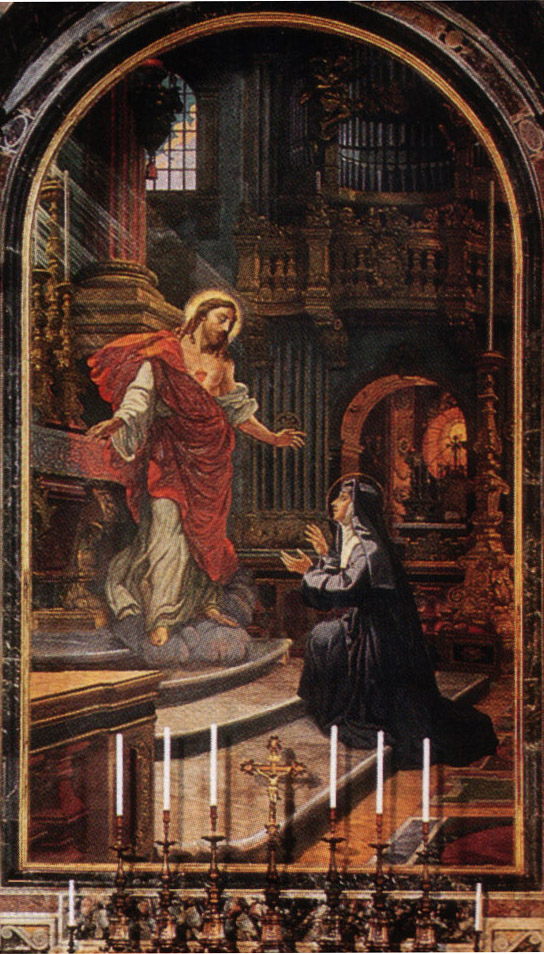
This realization was due to my coming to know St. Margaret Mary Alacoque to whom Jesus, as the Sacred Heart, appeared at her Visitation Convent of Paray-le-Monial in France. When he appeared to Margaret Mary, and displayed His heart, what she saw portrayed within Jesus’ opened chest was a heart aflame with the fire of his love. A crown of thorns encircling His heart symbolized the suffering He endured for the forgiveness of sin.
There was also the wound of the centurion’s lance from which flowed water and blood – the cleansing of the life-giving water of Baptism and the most precious blood of the Eucharist. Atop the sacred heart was imbedded a cross, the sign of Jesus’ all-consuming tenderness.
What I had come to know became even more alive when I had the opportunity to go to Paray-le-Monial. While I was teaching at Oxford, I organized a pilgrimage to Assisi for a group of Catholic students to pray at the tomb of St. Francis. I decided that a stop at Paray-le-Monial would be advantageous both for spiritual reasons and for a day of rest.
In a student-packed large English van with the steering wheel on the right, I drove through the night, a night that was pouring rain. When we arrived at the convent early in the morning, the sisters, who were expecting us, treated us to a magnificent breakfast and then sent us off to bed for a few hours’ sleep
Later that afternoon my pilgrim students and I celebrated Mass in the very chapel where the Sacred Heart appeared to Margaret Mary. My story climaxes here. The students and I perceived, as the liturgy progressed, a growing sense of holiness. The chapel and all of us within it were surrounded by and taken up into the vibrancy of Jesus’ Most Sacred Heart. At Holy Communion, we were all subsumed into Jesus’ benevolent heart. After Mass, as we walked around the sun-lit city, we all commented on what we had just experienced – the loving heart of Jesus.
We arrived in Assisi the next day and prayed at the tomb of St. Francis as we had always intended. But we had to admit that the high point of our pilgrimage was our time in Paray-le-Monial. Yes, our visit to Assisi was blessed, but it paled in comparison to what we experienced in a small village in the heart of France. The Sacred Heart of Jesus even outshone the stigmata of St. Francis, and rightly so, for Francis’ wounds were but an imitation of Jesus’ pierced heart.
The month of June is traditionally dedicated to the Sacred Heart of Jesus. This year, on June 11, as part of the celebration of the 250th anniversary of the signing of the Declaration of Independence, the U.S. bishops consecrated the United States of America to the Sacred Heart of Jesus. Given the moral and political state of our beloved nation, it is right and proper that such a dedication was enacted. The following is the prayer that the bishops have requested to be prayed by all the faithful.
O Most Sacred Heart of Jesus: You know the longings of our hearts, and you desire that we enjoy friendship with you. From your pierced side, you have poured out the wellspring of life, for which we thirst. Your heart burns with a love for all people to return to a right relationship with you. We celebrate the abundant gifts you have given this nation, founded on the self-evident truths that our Creator has endowed all people with the right to life, liberty, and the pursuit of happiness. We make reparation for the offenses against you and against human dignity that have taken place in this nation. May our hearts be united to yours, so that our families and communities enjoy peace and happiness; may broken relationships be reconciled, injustices repaired, and the wounds of our land be healed. May your holy Catholic Church serve as a sign, pointing all people to your infinite love. O Desire of Nations and Center of History, we ask you to bless these United States of America. Who live and reign with God the Father in the unity of the Holy Spirit, God, for ever and ever. Amen.