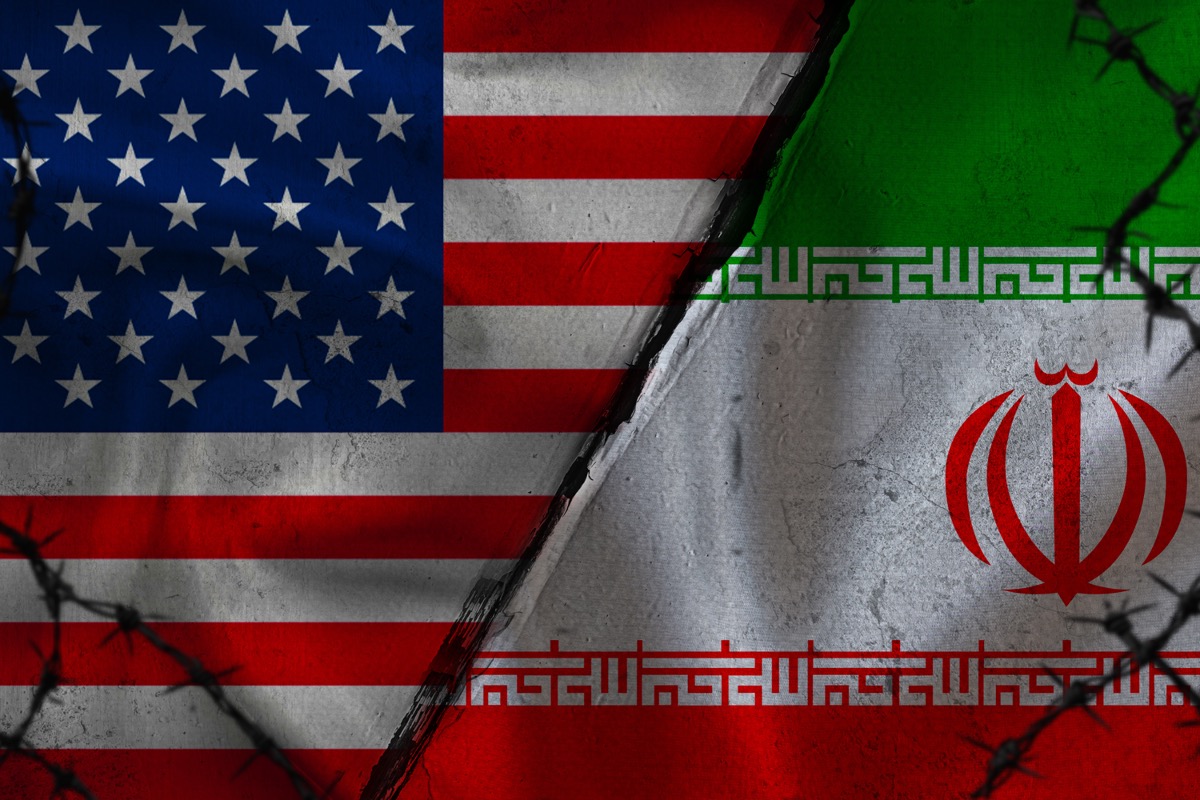
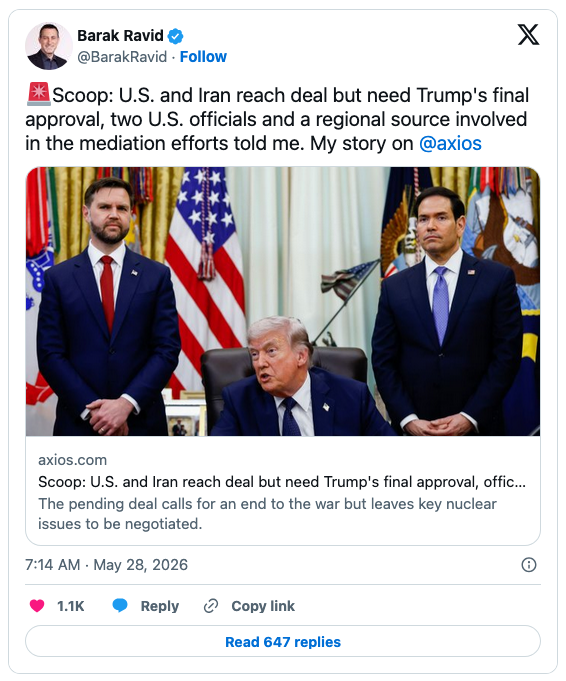
Iran and the United States have agreed to a 60-day ceasefire in their nearly three-month-long war and only await the approval of U.S. President Donald Trump and Iran’s top officials.
President Trump will think the deal over for a few days, Axios’ Barak Ravid reported in disclosing the agreement, which Reuters confirmed.
The report comes a day after Trump, during a Cabinet meeting, said he expected multiple Middle East nations to sign on to the Abraham Accords, a proposal he touted on Truth Social at length on Monday.
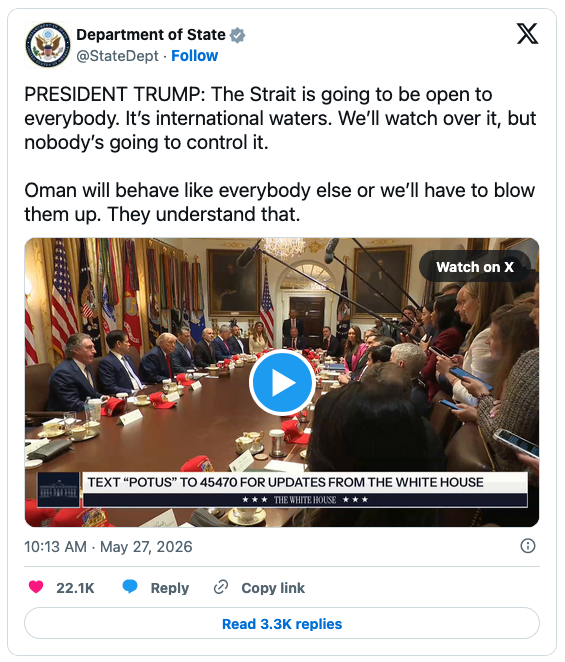
Also during that meeting, Trump said an agreement with Iran will reopen the Strait of Hormuz. The strait is “international waters,” he said, and Oman had better go along or “we’ll have to blow them up.”
Abraham Accords
As The New York Times reported on Sunday, U.S. and Iranian officials said the two sides had agreed to a memorandum of understanding (MOU) that would open the Strait of Hormuz, which carries 20 percent of the world’s oil supply, some 20 million barrels per day. The United States would lift its naval blockade of the strait.
Trump wrote on Truth Social on Monday that Qatar, Egypt, Jordan, Türkiye, and Pakistan should join Bahrain and the United Arab Emirates in signing the Abraham Accords that Trump negotiated in his first term. Indeed, Trump said, signing the accords should be “mandatory.”
Trump repeated that entreaty yesterday during a Cabinet meeting at the White House. Indeed, Trump said, those countries “owe that to us.” He said he could not sign a peace agreement if they didn’t sign the accords.
“I’m not sure we should make the deal, if they don’t sign,” Trump said. He said their signing the accords would be “great” for all of them.
That aside, said Axios:
U.S. and Iranian negotiators have reached an agreement on a 60-day memorandum of understanding to extend the ceasefire and launch negotiations on Iran’s nuclear program, but President Trump has yet to give his final approval, two U.S. officials and a regional source involved in the mediation efforts” tell Axios.
Iran has not confirmed that it has accepted the pact.
“This is an agreement to get everybody to the table. We will work out the details in the negotiations,” an official told Axios. As well, “U.S. officials said terms of the deal were mostly agreed to as of Tuesday, but both sides still needed approval from senior leadership.”
American officials told the website that “the Iranians later came back and said they had the necessary approvals and were prepared to sign,” but “Iran has not confirmed that.”
Nor was Trump ready to sign.
Trump “relayed to the mediators that he wants a couple of days to think about it.” a U.S. official told the website.
Opening the Strait
The 60-day MOU means that shipping through Hormuz will be “unrestricted,” meaning Iran will not charge tolls or harass ships and will remove mines within a month.
“The U.S. naval blockade will also be lifted, but that will happen in proportion to the restoration of commercial shipping, a U.S. official said,” Axios continued:
The U.S. would also issue some sanctions waivers to allow Iran to sell oil freely.
The MOU will include an Iranian commitment not to pursue a nuclear weapon, the officials said.
It will also state that the first issues to be negotiated during the 60-day window will be how to dispose of Iran’s highly enriched uranium and how to address Iranian enrichment.
The U.S. will commit to discuss sanctions relief and the release of frozen Iranian funds as part of the negotiations.
The memorandum will also provide a means for Iran to receive consumer goods and humanitarian aid, the website reported. Plus, “that the war between Israel and Hezbollah in Lebanon would end — an issue on which Trump and Israeli Prime Minister Benjamin Netanyahu have had at least one tense discussion.”
“The two U.S. officials claimed the Iranians had given verbal commitments during the negotiations about their willingness to make nuclear concessions, but ‘we will not know until we get in the room, which is why we want to do this MOU. It gets both sides into the room to negotiate directly,’” Axios continued.
Once the strait reopens, Trump told reporters during the Cabinet meeting, no one will control it, but the U.S. Navy will keep an eye on it. Trump also threatened Oman.
“The strait is going to be open to everybody,” Trump said:
It’s international waters. Nobody’s gonna control it. … We’ll watch over it, but nobody’s going to control it. That’s part of the negotiation that we have. They would like to control it. Nobody’s gonna control it.
It’s international waters, and Oman will behave like everybody else or we’ll have to blow them up. They understand that. They’ll be fine.
Allies, Israel Should Help Trump
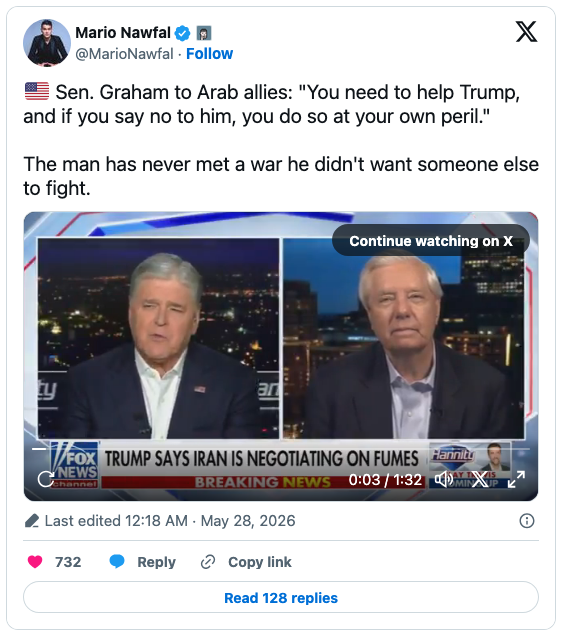
Last night, during an interview with chicken-hawk Fox bloviator Sean Hannity, Israel-first GOP Senator Lindsey Graham of South Carolina said America’s Arab allies must sign the Abraham Accords.
“You need to help President Trump,” he said to Arab nations:
You need to embrace the fact that it is now time to end the Arab-Israeli conflict, make peace with Israel, build on the Abraham Accords. And if you say no to him, you say no at your own peril.
Graham told Israel that it, too, should listen to Trump:
You owe it to him. You owe it to your people. You owe it to the world to do what he’s asking you to do. Build on the Abraham Accords.



![Hegseth Demands Fitness Requirements, Says 'Fat Troops' 'Not Who We Are' [WATCH]](https://teamredvictory.com/wp-content/uploads/2025/09/Hegseth-Demands-Fitness-Requirements-Says-Fat-Troops-Not-Who-We-350x250.jpg)