
The only time Our Lord came upon something merely flourishing, he cursed it: “In the morning, as he was returning to the city, he was hungry. And seeing a fig tree by the wayside he went to it, and found nothing on it but leaves only. And he said to it, ‘May no fruit ever come from you again!’ And the fig tree withered at once.” (Matthew 21:18–19)
The form of the curse was that it should flourish only and never fructify. For Our Lord, “May you simply flourish” is a curse. Since flourishing (“flowering”) is for bearing fruit, however, such a curse makes the tree wither.
Transpose the idea to human affairs, and we might say that on the one hand there is human flourishing, and on the other, human “fructification,” and to aim to flourish without fructifying is to be subject to a divine curse.
Then there is the parable of the tree which is not bearing fruit:
A man had a fig tree planted in his vineyard; and he came seeking fruit on it and found none. And he said to the vinedresser, “Lo, these three years I have come seeking fruit on this fig tree, and I find none. Cut it down; why should it use up the ground?” And he answered him, “Let it alone, sir, this year also, till I dig about it and put on manure. And if it bears fruit next year, well and good; but if not, you can cut it down.” (Luke 13:6-9)
This tree was certainly ‘flourishing,’ but it was to be cut down because it did not yield fruit.
The first Psalm, which gives the key to all the Psalms, says that a man who ponders and follows God’s law, “is like a tree planted by streams of water, that yields its fruit in its season, and its leaf does not wither. In all that he does, he prospers.” His prosperity consists in flourishing and fructifying both.
Indeed, if you pay close attention, you can see that Our Lord is almost fanatical about fruit: “I am the true vine, and my Father is the vinedresser. Every branch of mine that bears no fruit, he takes away, and every branch that does bear fruit he prunes, that it may bear more fruit.” (John 15:1-2)
He cares so much about fruit that he expects even what traditionally was regarded as sterile to bear fruit. The man who distributed the talents tells the man who had only one that he should have taken it to the bankers, where at least it could have earned interest. (Matthew 25) In Greek, the word for interest is tokos, which means offspring of a womb. For the Lord, no domain of human life is exempt from the law of fructification.

In light of all this, one might at least raise an eyebrow at all the recently founded programs which say they are devoted to “human flourishing”: the Human Flourishing Program (Harvard), the Institute for Global Human Flourishing (Baylor), the Institute for the Study of Human Flourishing (Oklahoma), the Center for Theology, Science and Human Flourishing (Notre Dame), and the Global Center for Human Flourishing (Liberty University), among others.
Do these programs, embedded in a society marked by sterility and self-centeredness, offer anything ultimately different? The Templeton Foundation funds many of them under its “Character Virtue Development” heading, the same unit in Templeton which funds “voluntary family planning” programs in sub-Saharan Africa, on the premise that large families impede economic development.
What is the essential difference between an intent to flourish, and an intent to fructify? It consists in the willingness to die for others. Our Lord teaches this principle explicitly: “Truly, truly, I say to you, unless a grain of wheat falls into the earth and dies, it remains alone; but if it dies, it bears much fruit.” (John 12:24-25)
“Flourishing” is demonstrably a Boomer term. The men of the Greatest Generation, when they went off to war, did not conceive of themselves as going off to flourish. Rather, each was prepared to give up his own flourishing for a cause he believed to be just.
Justice Thomas, in a recent speech at the University of Texas in Austin, referred to this attitude as a “devotion” which inspires true courage. That is why, he said, the last sentence of the Declaration is as important as the first:
Nothing in the Declaration of Independence, I now realize, matters without that final sentence. . . .What changed the world was not the words, but the commitment and spirit of the people who were willing to labor, sacrifice, and even give their lives – what Lincoln at Gettysburg called “the last full measure of devotion” – for the Declaration’s principles.
He concludes: “It is that devotion that we are missing today, and that we must find in our hearts if this nation is to endure.”
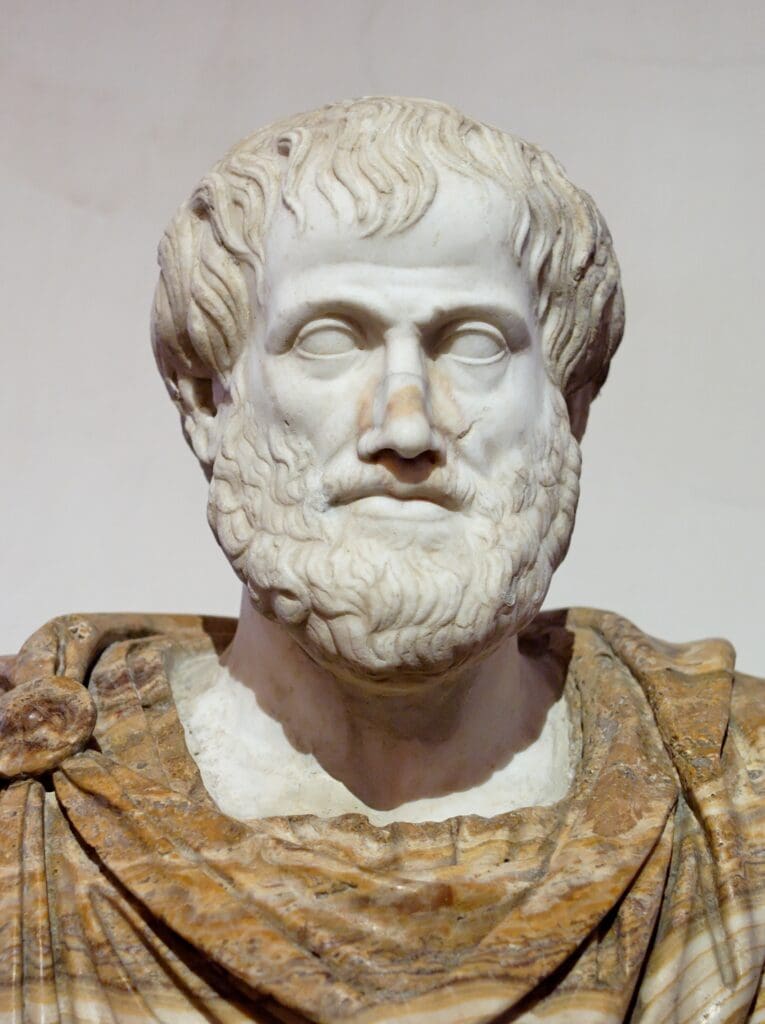
How did we end up with so much “flourishing”? Sadly, philosophers are to blame. We were looking for a word to express in English Aristotle’s conception of happiness as eudaimonia. Our own concept of happiness looks subjective – a lasting pleasant feeling. But Aristotle’s eudaimonia is objective (someone can be wrong about whether he has it), as it brings in a way of life. Eudaimonia is activity in accordance with virtue over a complete life.
“Flourishing” seemed to get that idea across better. At least it was not misleading.
The term is indeed misleading, as regards a Christian understanding of happiness, which implies a willingness to make a radical gift of self, involving some kind of death.
It always was misleading, even as an interpretation of Aristotle. For Aristotle, only rational beings can enjoy eudaimonia, because eudaimonia is ultimately a sharing in the life of God. “Flourishing,” in contrast, is universal and species-relative. A plant can flourish. My golden doodle can flourish. Eudaimonia is emphatically not the analogue in man of a flourishing golden doodle.
Aristotle was wise enough to see that the pursuit of eudaimonia must therefore lead to something transcendent:
We must not follow those who advise us, being men, to think of human things, and, being mortal, of mortal things, but must, so far as we can, make ourselves immortal, and strain every nerve to live in accordance with the best thing in us. ( Nicomachean Ethics X.7)
Such fructifying flourishing, for a Christian, implies the pursuit of holiness, the embrace of a vocation, and true courage.









![WHAT POLICY? Crockett Trips Through MS NOW Softball Question on Her Agenda if Elected to Senate [WATCH]](https://teamredvictory.com/wp-content/uploads/2025/12/WHAT-POLICY-Crockett-Trips-Through-MS-NOW-Softball-Question-on-350x250.png)