The Department of Defense recently made waves over a decision to remove Mormons from the category of “Christian,” to distinguish more clearly among the chaplains and the servicemen as to who might best minister to them in matters of faith and morals. The label seems to be intended as a generic marker, as the department went on to separate Catholics, Lutherans, and Pentecostals from the category also, granting each a distinct status.
The decision caused a ruckus, and a lot of hurt feelings among Mormons who insist that they are Christian, and that they do look upon Jesus Christ as their Lord and Savior. I am disposed to credit their earnestness, though what their church teaches about the Father, the Son, the Holy Spirit, the angels, and other planets seems to me a jungle of nineteenth century American mysticism and utopianism.
It’s as if northern American religious sensibility met a fork in the road, and the Unitarians went one way, towards trading the faith for social amelioration, conventionality, and vague inner feelings, while Joseph Smith went the other way, towards myth-making and building up a society from its foundations. Which of them prevailed seems obvious. Where is the Unitarian Tabernacle Choir?
The real question for Catholics is not whether Mormons are Christian, but whether all of us Catholics are Catholic, or Christian, for that matter. What is the minimal standard that divides Christian from not-Christian?
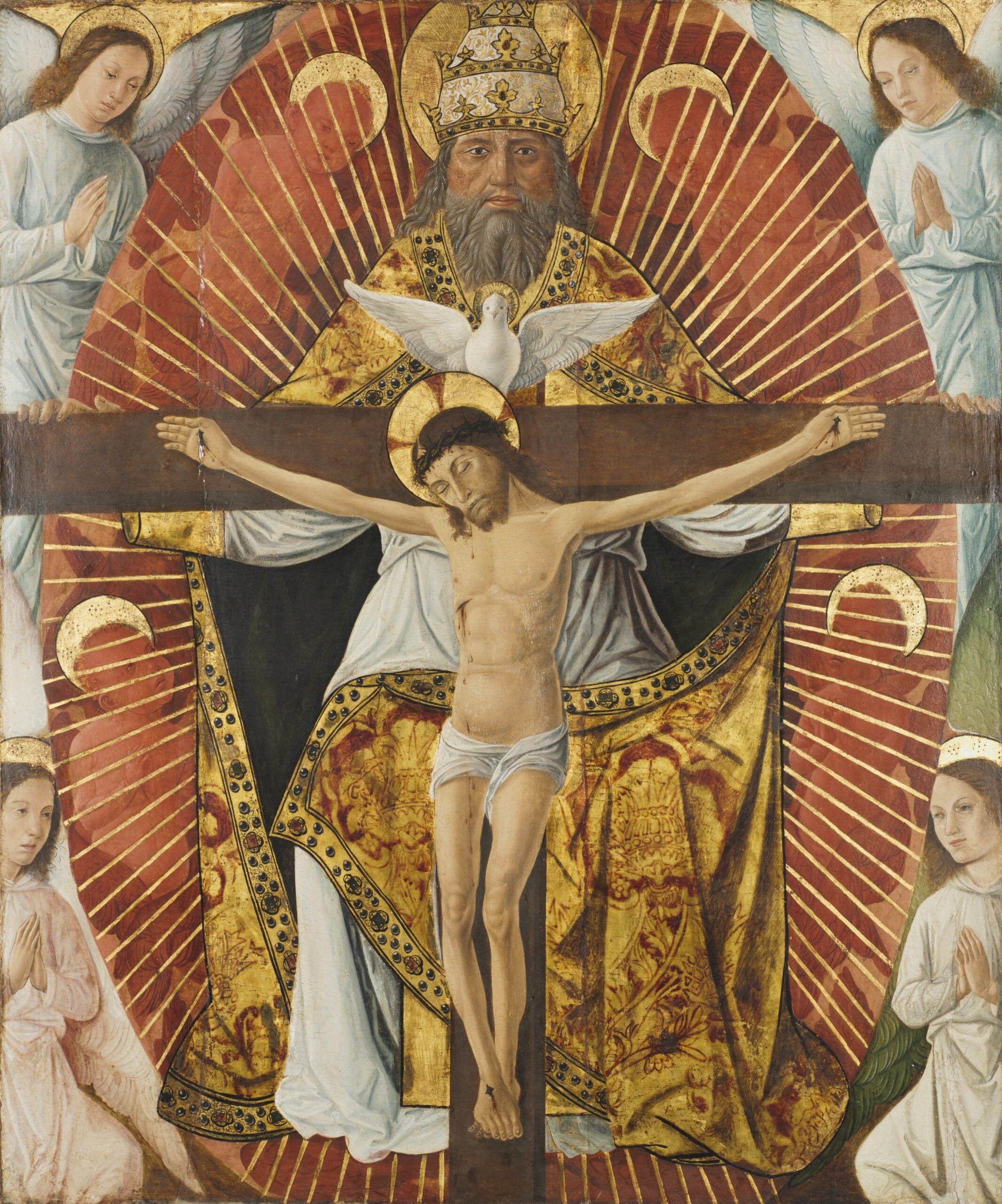
It must be in answer to the question, “Who is Christ?”
We have that question answered for us in Scripture. “Thou art the Christ, the Son of the living God,” says Peter. (Matthew 16:16) “He is the image of the invisible God,” says Paul. (Colossians 1:15) He is the Word, who was in the beginning with God, and who is God, says John. (John 1:1)
Only as such can He be our Savior, rather than a merely great man whom we should emulate; though for a long time, Unitarians and their cousins the Quakers wished very much in their hearts to honor Christ as Lord, though their doctrines had demoted Him. And now, it appears, they no longer trouble themselves over it. Jesus may as well be Buddha, or Buddha be Jesus.
What answers you may get from Catholics whose attendance at Mass is spotty. No doubt they will vary from nation to nation. I would like very much to believe that in Italy, the land of my forebears, the Son of God has not been relieved of His throne beside the Father, embosomed with Him in the Holy Spirit from all eternity. But perhaps I am underestimating the corrosion that sets in with the creed of humanitarian and technological progress, which must relegate even Jesus to but a stage along the way.

Suppose we go farther, and, among Catholics who agree that Jesus is the Son of God, co-eternal with the Father, ask them about his full and real presence in the Eucharist.
Martin Luther, I am told, frustrated with Ulrich Zwingli’s anti-sacramentalism, took a knife out of his pocket and carved the words Hoc est corpus meum on the table they were sitting at, asking him, “Which of these words do you not understand?”
Is the American Catholic less sacramental than Luther? Or rather, at which churches will you find such Catholics who do not embrace this teaching with full assent and joy? They either must not attend to what they are saying, or must hedge it with reservations, or must say it with an uneasy conscience when they pray, “Lord, I am not worthy that you should enter under my roof.”
Central to all Catholic teaching on the social life of man is marriage, inscribed in the bodily nature of male and female, instituted by God in the beginning before the Fall, and confirmed by Jesus and elevated to a sacrament that cannot be undone. Without marriage and family, there is no real society for which social teachings may be applied, just as medicine is not applicable to a body blown to bits.
What we see instead among us is a wraith, a simulacrum of the social. Rifle all the assets of the rich and spread them abroad, and you still will have no society, not when children are few, marriages are frail, and the people are not a people but an aggregate, united by no common worship, and not even a common culture anymore, nothing but whatever the mass media have on offer.
And yet we meet Catholics who take pride in rejecting the Church’s teachings that apply to marriage and family life, using her economic and political teachings as a cover, which is like handing deodorant and makeup to someone dying of gangrene.
I judge no souls here. How close an individual Mormon may be to Christ, I cannot know. Only God can know that. The same goes for the Catholic who is a jumble of intellectual and even moral confusion. I may say, judging from his beliefs, that he is a bad Catholic, or no Catholic at all, perhaps not even Christian.
But it is not a new thing in the world that there may be bad Christians and virtuous pagans, so far as things appear to our eyes. The danger lies not in how others look upon us, but in how we look upon ourselves since man’s capacity for self-deception is boundless.
If no one should say, “I am a good Catholic because I believe all that the Church teaches,” then far less should anyone say, “I am a good Catholic even though I do not believe all that the Church teaches.” Much less, “I am a good Catholic because I do not believe what the Church teaches for now,” presuming to know what she is going to teach instead, as if she could contradict herself without destroying her very essence and her claim to teach anything at all.
There, and not in what the Department of Defense did, lies the real issue.