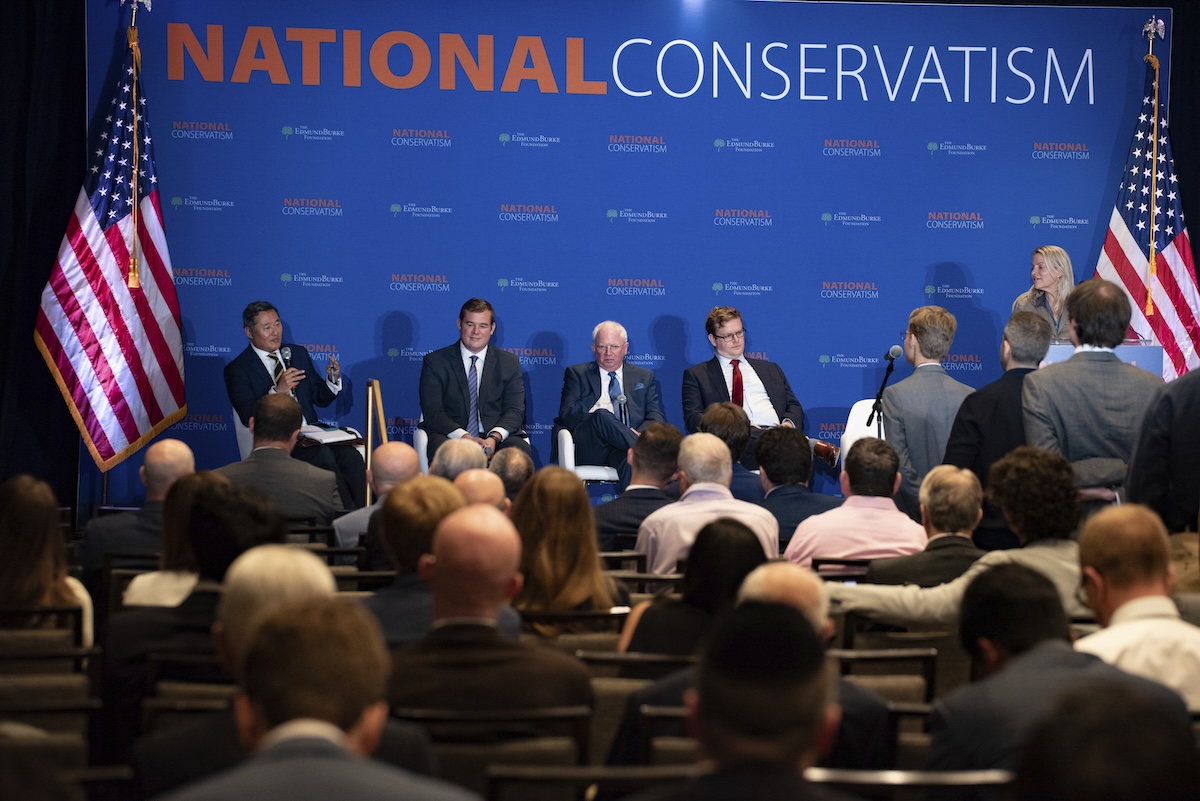
In the fall of 2017, I was invited to attend the Ramsey Colloquium in Washington, a gathering convened by R.R. Reno to discuss a paper by Philip Pilkington titled “Our Broken Neoliberal Orthodoxy.” The setting was a dingy conference room in a retreat center that looked as if it had last been renovated during the Johnson administration. Twenty-odd scholars and intellectuals sat around tables arranged in a large square—mostly men in tweed jackets. Among them were several figures I would later come to recognize as architects of what was then still a nameless movement. I was a standout: a junior professor and a mother of eight, my youngest a few days shy of his first birthday. I had come up reading First Things in the 1990s. I had read my share of political theory. I was a classically trained economist. I thought I knew the landscape.
Pilkington held court. His paper argued that forty years of “neoliberal” economic orthodoxy—deregulation, free trade, the erosion of unions—had hollowed out the Western middle class and rotted its moral fiber. Some of his instincts struck me as sound: yes, elites had grown detached; yes, communities were fraying. But his framework was troubling. His training in economics was thin, and it showed—not in his diagnosis of symptoms, which was often vivid, but in his inability to distinguish a market failure from a policy failure, or a structural trend from a moral choice. Economics as a discipline was not being critiqued. It was being indicted.
I discovered that afternoon that I was, in the eyes of the room, both a neo-conservative and a neo-liberal—and that both were terms of contempt. I had never heard the word “neo-liberal” used this way. I did not think of myself as a neo-conservative, either, though I had learned from men so labeled, such as Richard John Neuhaus. At one point, growing worried about his interventionist prescriptions, I asked Pilkington a basic question: “Where do prices come from?” Annoyed, he waved me off. Later, I suggested that some of his claims could be tested—that we could do studies. One American academic, who today works in Hungary, sneered: “How many more studies do we need?” The room murmured its assent. I saw then that something was afoot that I had not encountered before. It was not that these conservatives had reached different conclusions than I had. It was that the enterprise of reaching conclusions—of fixing claims to evidence, of reasoning from principles of human action to testable propositions—was itself under suspicion.
I had celebrated the language of freedom and limited government in the 1980s under President Reagan, but I had also believed the federal government had in fact expanded, not contracted, during his tenure. I was critical of the Reagan era—but for reasons precisely opposite to those gathering force in that room. Reagan had not liberalized enough. For the people around the table, however, Reagan’s sin was that he had liberalized at all: he had talked a moral vision of American freedom while selling out to corporate interests and Wall Street, deregulating at a ruinous pace, and setting the stage for everything they despised. “Rotting flesh Reaganism,” Reno had already dubbed it.
I left the colloquium that October with the uneasy feeling that the tradition of conservatism with which I was most closely aligned—the conservatism of Russell Kirk and Winston Churchill, of limited government, ordered liberty, and the free association of families and communities—was being summoned to the guillotine. The executioners were not liberals. They were a new breed of revolutionary whom I had barely registered until that afternoon, and who would soon have a name.
That name, when it arrived, was “postliberalism”—though it traveled under several aliases, including, paradoxically, conservatism. The word I kept hearing in those years was “neo-liberal,” and I have since come to understand what it meant to people like Pilkington and Patrick Deneen. A neo-liberal, in their telling, was anyone who believed that markets could give rise to Providential order, that deregulation was generally sound, and that the Reagan-Thatcher revolution was on the whole a good thing. A neo-conservative was the same creature wearing a flag pin: someone who wedded free-market economics to an aggressive foreign policy and called the result “freedom.” Both labels were terms of contempt, and both were applied to me—and to anyone who defended the broad outlines of the American economic and constitutional order since 1980.
The economic historian Phil Magness has shown that “neo-liberalism,” as a term of political abuse, does not correspond to any intellectual tradition that anyone actually professes. No one calls himself a neo-liberal. The word exists to make a set of positions unsayable—to collapse the distinction between a corrupt cronyism that deserves criticism and a principled defense of free exchange and limited government that deserves argument. The neo-liberal label is a heresy marker, not a category of analysis. And “neo-conservative” functions the same way, absorbing figures as different as Irving Kristol and Richard John Neuhaus into a single epithet and discarding the need to engage any of them on their actual terms.
What struck me then, and strikes me more forcefully now, is the irony buried in the postliberal method. Here was a movement that claimed to recover something pre-liberal—to reach back behind the Reformation, behind the Enlightenment, behind the whole catastrophe of modernity, to a medieval synthesis of faith and political order. And yet the characteristic intellectual move of postliberalism is not classical at all. It is Hegelian. The postliberal narrative—from sacral kingship through Reformation through liberalism to the present crisis—is a story of progressive historical necessity. Thesis, antithesis, synthesis. There is nothing more modern, nothing more indebted to the nineteenth-century philosophy of history, than this sweeping civilizational arc. The postliberals dress Hegel in a Dominican habit and call it tradition. It is no accident that Carl Schmitt—a Nazi party member, yes, but more to the point, a theorist who made the political the foundational category of human life—has become something of a patron saint for the movement. Schmitt is the postliberals’ real governing spirit, not Aquinas.
And the labels reveal the deeper problem. Postliberals traffic endlessly in nominal categories—right-liberals, left-liberals, regime liberals, neo-liberals, neo-conservatives—yet they rarely pause to fix principles. What is human nature? What are the natural forms of human association? What are the conditions under which families form and sustain themselves, under which men and women find productive work and educate their children? These are not questions the postliberals ask, because asking them would require descending from the level of civilizational narrative to the level of human action—and at that level, the grand taxonomy dissolves. Something deeply liberal, in the old pejorative sense of rootless and constructivist, animates the postliberal project. It is impatient with givenness. It prefers the map to the territory.
I have come to believe that postliberalism failed for a reason more fundamental than bad politics or bad history, though it has plenty of both. It failed because it lacks an adequate account of human nature and civil society.
The postliberals claim to be classical—to stand in the tradition of Aristotle and Thomas Aquinas, of natural law and the common good. But they reject what is perhaps the most fundamental tenet of classical political philosophy: that the family and civil society are prior to the political order. For Aristotle, the household comes first. The village comes next. The polis emerges to serve these natural communities, not to constitute them. For Aquinas, the same principle holds, deepened later by the Leonine doctrine of subsidiarity—that what can be accomplished by smaller and lower communities should not be absorbed by larger and higher ones. The political order exists for the sake of human life well lived, and a good life begins in the family, not in the state.
The postliberals have inverted this. For them, the political is primary. The state is the great instrument—the lever by which a fallen civilization will be righted. They speak of “regime change” without irony, of capturing bureaucracies and redirecting them toward a theological vision of the good. They imagine that if the right people held the right offices, the right culture would follow. This is not a recovery of classical thought. It is a betrayal. It is, in fact, a form of the very liberal constructivism they claim to oppose—the belief that the right design can produce the right decision.
And so postliberalism operates at the level of surface tension. It thinks in aggregates: systems, structures, regimes, civilizational orders. It gestures at the grand scale while ignoring the principles of human action that actually govern how people live. What are the incentives that lead a young man to marry or not? What are the conditions under which a family of modest means can educate its children according to its convictions? What institutional arrangements—property rights, contract law, local governance, freedom of association—make it possible for communities to solve problems? The postliberals have no answers to these questions, because they have helped themselves to a tradition they have not learned. And they remain remarkably incurious about the foundations of the oikos: sound marriage and sound money. Their intellectual life is conducted inside a simulation—a vast and elaborate (mostly male dominated) Sim City of political thought, complete with its own worlds, labels, jargon, roles, and inside jokes, none of which make sense on Main Street.
The sneer at “doing studies” was the tell. A movement that dismisses empirical inquiry about human behavior cannot build a politics adequate to human beings. It can only build a politics adequate to its theory—and when the theory fails, as it always does, it will blame the people for not living up to the model.
The postliberals have rejected Wall Street, and good for them where the criticism is earned. But they have moved into their own gated district—call it Elite Street—adopting a new form of managerial ambition while denouncing the old one. They reject the laptop class and long for a crozier class. What people need—how to get married, where to educate their children, how to make a living—remains unanswered. The framework is Marxian and Hegelian: diagnose the structure, name the enemy, promise the transformation. The granular work of understanding human choice and building robust institutions is left undone. They are liberals in postliberal clothing.
This is why a book like Why Postliberalism Failed matters. What the authors, James M. Patterson and Thomas D. Howes, have accomplished here is something that has not been adequately done until now: a rigorous, historically documented account of what actually happened every time the postliberal vision was implemented. The record is specific and it is damning. In Portugal under Salazar, in Brazil under Vargas, in Franco’s Spain, in Vichy France, in Tiso’s Slovakia, in Pavelić’s Croatia—everywhere the postliberal project was tried, it produced economic stagnation, political repression, and the corruption of the Church it claimed to serve. In several cases it enabled or actively collaborated in genocide. The authors show that contemporary postliberals—Adrian Vermeule, Patrick Deneen, and Gladden Pappin—have explicitly praised these regimes and the reactionary thinkers who legitimized them, and they show the intellectual lineage that connects today’s movement to the anti-Semitic conspiracy theories and fascist collaborations of the twentieth century.
But the book does not only tear down. It recovers a tradition that is genuinely worth defending: the American Catholic republicanism of Archbishop John Hughes, James Cardinal Gibbons, Archbishop John Ireland, Fulton Sheen, Dorothy Day, and John Courtney Murray. These figures did not need to dismantle the constitutional order to live as faithful Catholics. They flourished within it—and in doing so, they built parishes, schools, hospitals, and civic institutions that served millions. Their tradition is the proof that the postliberal premise is false: you do not need a confessional state to have a faithful Church.
Where does this leave us? The postliberal moment is not over, but its intellectual peak has passed. What remains is the political residue—figures in positions of influence who absorbed the rhetoric without ever interrogating the history, and a generation of young Catholics who were promised a heroic counter-narrative and given a graduate seminar in resentment. The real danger now is not that postliberalism will succeed but that its failure will discredit the legitimate concerns that gave it an audience: the fraying of communities, the loss of dignified work, and the sense that the nation’s institutions no longer serve its people.
These are real problems. They deserve real answers—answers rooted not in civilizational fantasies but in a serious account of human nature, the family, and the institutions of civil society. The Aristotelian-Scholastic tradition of natural law, in its American and Catholic incarnation, offers such an account. It has always offered such an account. It was there before the postliberals arrived, and it will be there after they are forgotten. The alternative to postliberalism is not liberalism.
I am sometimes asked whether I am a conservative or a liberal. I find that I am neither of these things, if by them we mean the caricatures that populate the postliberal taxonomy. Friedrich Hayek once explained why he was not a conservative. My task is simpler: I am not a conservative and I am not a liberal, because as the postliberals use these words, they describe no one. I am a Catholic who holds that the natural law is knowable by reason, that the family is the first society, that the state exists to serve and not to constitute the good life, and that the American constitutional tradition—for all its flaws and unfinished business—remains the best political arrangement yet devised for allowing men and women to live according to these truths. I did not arrive at this position by rejecting liberalism or embracing it. I arrived at it the way most people arrive at their deepest convictions: by trying to raise my children, do my work, and understand the world as it actually is, rather than as some theory requires it to be.
That is what the authors of this book have done. I commend it to you.
(This essay is one of the forewords to James M. Patterson and Thomas D. Howes’s forthcoming Why Postliberalism Failed, published by the Acton Institute.)