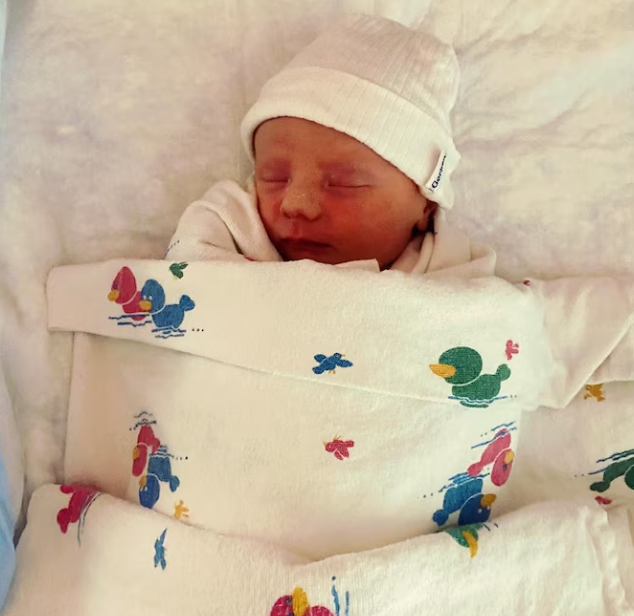
Doctors at Texas Children’s Hospital successfully performed what they describe as the first surgery of its kind in the United States on an unborn baby to correct a severe intestinal defect.
The surgery is allowed the child to be born full-term and healthy.
Theo French, now 5 months old, was diagnosed at his mother’s 20-week ultrasound with complex gastroschisis, a condition in which the baby’s intestines develop outside the body through an opening in the abdominal wall. The defect left the unborn child’s organs exposed to amniotic fluid, risking severe damage.
Complex cases of gastroschisis can require months in a neonatal intensive care unit, multiple surgeries after birth, prolonged intravenous feeding, and in some instances prove fatal, with mortality rates of about one in 10 even under the highest level of care.
HELP LIFENEWS SAVE BABIES FROM ABORTION! Please help LifeNews.com with a donation!
Maisie Savage, 29, and Josh French, 36, both teachers from London, learned of their son’s diagnosis during what they expected to be a routine scan.
“We were super anxious and scared and worried,” Savage said in an interview that aired Wednesday on “Good Morning America.”
“It is just a really difficult time for us as a family to process what the start of Theo’s life was looking like it was going to be.”
Specialists at Great Ormond Street Hospital in London referred the family to an FDA clinical trial at Texas Children’s Hospital led by fetal and pediatric surgeons. Theo became the third baby worldwide—and the first in the United States—to undergo the pioneering procedure.
Before the main surgery, specialists in Belgium administered a Botox injection through the womb to relax the unborn baby’s abdominal wall muscles.
At 26 weeks of pregnancy in November 2025, surgeons partially exposed Savage’s uterus, drained the amniotic fluid and replaced it with carbon dioxide gas to create operating space, then used minimally invasive keyhole techniques to gently push Theo’s intestines back into his abdomen and close the opening.
“Instead of making a big incision into the uterus to get to the baby, we use this tiny keyhole surgery and then carefully push the intestine back into the abdomen and then close the abdominal wall,” said Dr. Sundeep Keswani, associate surgeon-in-chief at Texas Children’s Hospital and principal investigator of the trial.
The approach builds on techniques pioneered at the same hospital for treating spina bifida in unborn babies, procedures that have demonstrated high survival rates and improved long-term outcomes by treating the child as a distinct patient before birth.
Dr. Michael Belfort, obstetrician and gynecologist-in-chief at Texas Children’s and clinical lead on the trial, said the results were “just remarkable,” noting zero complications during or after the fetal surgery.
“The mother, the baby, the surgery, the time of the surgery, the fact that we had zero complications during the foetal surgery and after the foetal surgery, just remarkable,” Belfort said.
Theo remained in the womb to continue growing and healing. He was born full-term by vaginal delivery in Texas at normal weight in February.
“He was delivered at term, at normal weight, came into this world just like any other baby, started breastfeeding, and by two days was on full feed,” Keswani said. “By day three, [he was] discharged from the hospital.”
Savage described the recovery as difficult, noting a scar roughly twice the size of a typical C-section incision and the sensation of her unborn son kicking against it for the remaining 14 weeks of pregnancy.
“It was a hard recovery,” she said. “But, it was worth it.”
She added: “Everything they did just completely reversed what could have been a really horrible start to his life and he’s just the best. He’s a completely normal baby essentially.”
“He’s a little miracle, isn’t he?” Savage said.
Her husband agreed: “He’s such a fantastic little man. He is doing everything that a normal baby should be doing.”
The family has returned home to the United Kingdom, where Theo continues to thrive.
Professor Paolo De Coppi of Great Ormond Street Hospital, part of the international trial team, noted that previous success rates with spina bifida surgeries “indicate this could essentially offer a cure for gastroschisis. If the results are positive, we hope this could become the standard operation for complex gastroschisis cases. Families can go home sooner after birth with a healthy baby that shows few signs of their bumpy start in life.”
The case underscores advances in prenatal medicine that recognize and treat the unborn baby as a patient deserving of surgical care to preserve life and improve outcomes before birth.