Defenders of a free and virtuous society have shown a renewed interest in the life and work of Frank Meyer, the 20th-century conservative intellectual and founding senior editor at National Review. Daniel Flynn produced a biography of Meyer last year and Stephanie Slade, a Fellow in Liberal Studies at the Acton Institute, will publish her book on the legacy of fusionism in September.
Fusionism—Meyer’s most significant contribution—embraced and promoted the idea that politics should enlarge and protect personal freedom, enabling the individual to seek after virtue. Through portraying these two ends—political liberty and individual morality—as complementary, Meyer laid the theoretical groundwork for the alliance between libertarians and social conservatives that swept Ronald Reagan to the White House. For this reason, Matthew Continetti has affectionately labeled him as Founding Fuser, even though Meyer always insisted that he had not haphazardly “fused” two unrelated viewpoints like a Frankenstein philosopher.
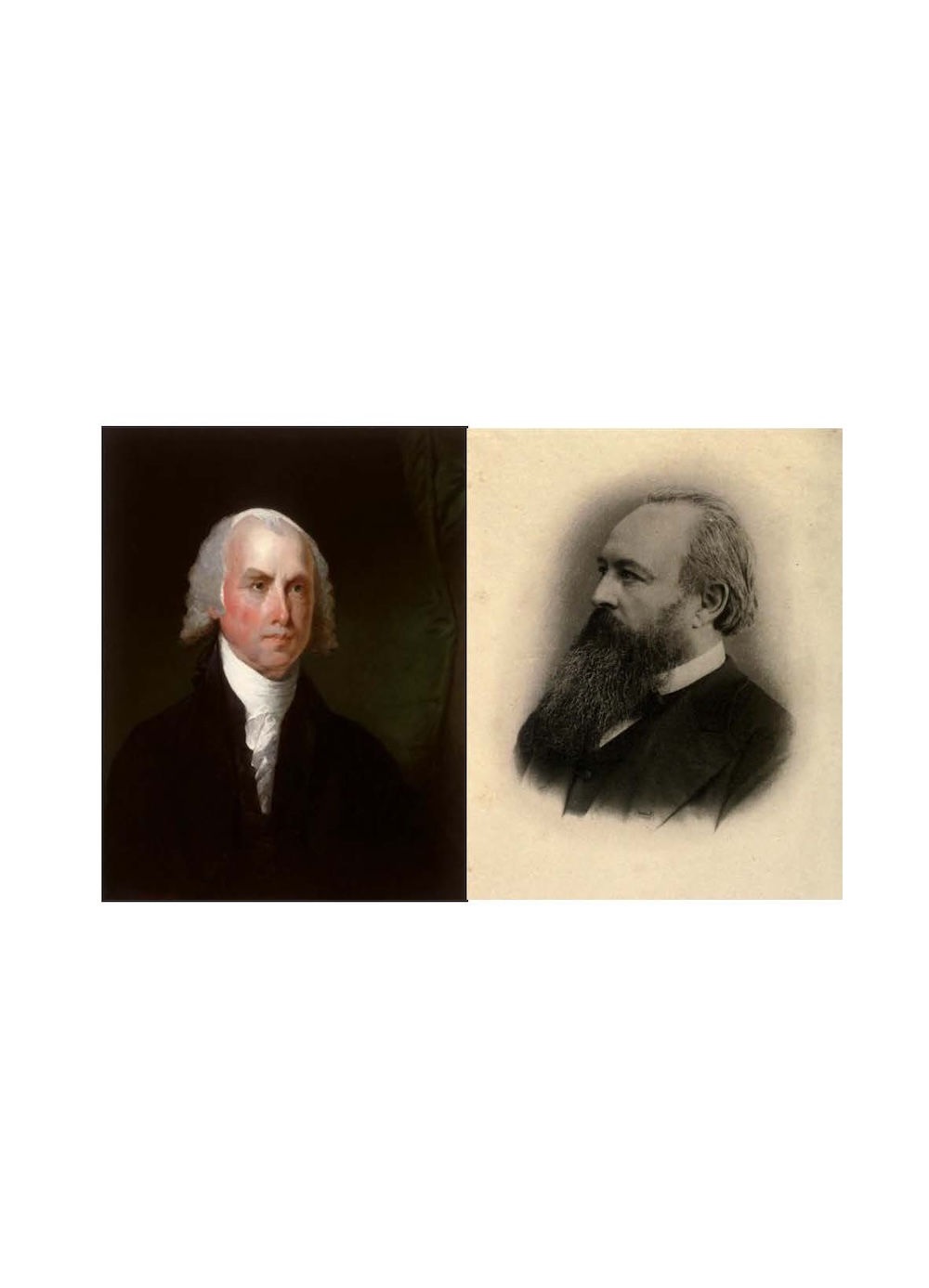
To the contrary, Meyer remarked in his collection of essays In Defense of Freedom that the fusionist (or “synthesis,” his preferred term) position had been touched on again and again by “Madison and Calhoun, in England by Acton and Percy, to mention only one or two.” Lord Acton’s and James Madison’s arguments in favor of individual liberty captured for Meyer the creative synergy between freedom and virtue that had developed in Western civilization and reached its apotheosis with the creation of the American republic. Asserting that the dictates of conscience called for limitations on the state and the enshrinement of religious liberty, Acton and Madison produced what became the outline for a fusionist understanding of politics, freedom, and virtue.
A historian of political freedom, Acton saw the gradual unfolding of individual liberty in the West as serving a markedly moral function: the protection of conscience. In The History of Freedom in Antiquity, Acton defines liberty as “the assurance that every man shall be protected in doing what he believes his duty, against the influence of authority and majorities, custom and opinion.” Acton avowed that one’s own sense of God’s bidding ought to take preeminence over any mortal power that vied for the allegiance of the human soul, while acknowledging that freedom of conscience could only practically materialize as “the delicate fruit of a mature civilization.”
According to Acton, the first seeds of liberty sprang to life in Jerusalem and Athens with the “principle that all political authorities must be tested and reformed according to a code which was not made by man.” A divine law that existed in a realm above human decrees and customs aroused and laid claim to the voice of conscience. In his commentary on Sir Erskine May’s Democracy in Europe, Acton observed that Socrates had urged men “to judge of right and wrong not by the will or sentiment of others, but by the light which God has set in each man’s reason and conscience.” In a landmark moment in the history of liberty, Socrates, Plato, and Aristotle “vindicated conscience against authority, and subjected both to a higher law.”
Nevertheless, Acton stated that it belonged to first Stoicism and then Christianity to universalize the implications of divine law and the primacy of conscience. The Stoics’ guide for conduct was “the voice of God, who comes down to dwell in our souls,” and their test of good government was its “conformity to principles that can be traced to a higher legislator.” Hence, their belief in natural law and a shared human nature “implied the existence of rights and duties common to all men, which legislation neither gives nor takes away.” Christianity likewise ushered in a radical sense of human equality, but it was above all Christ’s words “Render unto Caesar the things that are Caesar’s, and unto God the things that are God’s” that were for Acton “the repudiation of absolutism and the inauguration of Freedom.”
In an unprecedented historical event, Christianity separated church and state into distinct spheres of authority. Government had legitimate power to act in the sphere in which it was competent: casting judgements on matters of immediate political concern. In matters of religion, government could only illicitly intrude upon the relationship between God and the individual—inevitably resulting in tyranny and the violation of conscience.
“Liberty,” Acton declared, “is not a means to a higher political end. It is itself the highest political end.” When government elevated individual freedom as its raison d’être, it provided “security in the pursuit of the highest objects of civil society, and of private life,” which for Acton were religion and the battle against spiritual and moral temptation. Acton consequently considered political liberty—which equally protected minorities and majorities alike—the “essential condition and guardian of Religion.” Freedom from political oppression afforded the individual space to seek after God in private devotion and among fellow believers.
Yet the struggle for liberty in every age demonstrated that “friends of freedom have been rare.” Liberty of conscience had periodically been stymied by both the tyranny of the despot and the tyranny of the majority—“to whom must be rendered the things that are Caesar’s and also the things that are God’s.” Acton’s knowledge of history and view of human nature led him to the conviction that unlimited power “corrodes the conscience” and, as his most famous dictum holds, “Power tends to corrupt and absolute power corrupts absolutely.” Liberty expanded, then, to the extent that political power was dispersed and subjected to the rule of law.
Looking to the United States, Acton found a “democracy in its highest perfection.” With its constitutional safeguards against tyranny—such as federalism, separation of church and state, the Senate, and the Supreme Court—the American government divided sovereign authority. America’s distrust of power emerged from a political tradition that had long esteemed the principles of equality and toleration going back to William Penn and the Quakers. And in Madison and the American Founders, Acton found kindred spirits.
Knowing that men were not angels, Madison contemplated the tendencies and foibles of human nature when defending America’s constitutional system. In Federalist No. 51, Madison described how political power would be divided among the departments of government, so that ambition in one branch of government would be checked by ambition in another. In a compound and federal republic, power would be further shared with the states.
Like Acton, Madison feared the tyranny of both rulers and majorities that infringed upon the rights of minorities. By pushing power down to the federal level and creating a society of many different parties, interests, and sects, the Constitution rendered tyranny unlikely. America’s political system of checks and balances protected liberty and manifested Madison’s belief that government was the greatest of all reflections on human nature.
Madison also deemed limited government as the precondition for freedom of conscience. In his Memorial and Remonstrance against Religious Assessments, he listed his reasons for opposing a Virginia state bill that would have provided public funding for teachers of the Christian faith. Quoting the Virginia Declaration of Rights, Madison proclaimed that “‘Religion, or the duty which we owe to our Creator and the manner of discharging it, can be directed only by reason and conviction, not by force or violence.’ The Religion then of every man must be left to the conviction and conscience of every man.”
Like Acton, Madison placed the claims of conscience—or the relationship between the individual and God—prior to the claims of the state. “Before any man can be considered as a member of Civil Society,” Madison noted, “he must be considered as a subject of the Governour of the Universe.” If all men are created equal, moreover, then all have an equal freedom to profess or deny the dominant religion; for it is God, not man, to whom all will give an account.
Evoking the separate responsibilities of church and state, Madison scoffed at the arrogant idea that political government could be “a competent Judge of Religious Truth.” Such hubris had time and again proved pernicious to both religion and liberty. Madison maintained that centuries of established religion in Europe had wrought only “bigotry and persecution.” Either the state encouraged spiritual tyranny or the church abetted political tyranny: In no circumstance have religious establishments ever “been seen the guardians of the liberties of the people.” The just government, Madison concluded, protected “every Citizen in the enjoyment of his Religion with the same equal hand which protects his person and his property.”
In the fusionism of Madison and Acton, Meyer found grounds for his conviction that “truth withers when freedom dies, however righteous the authority that kills it.” Virtue, Meyer upheld, can truly be virtue only if it is freely chosen. In an era when notions of state-enforced morality have gained popularity on both the left and the right, lovers of liberty would do well to remember Meyer’s summary of the fusionist tradition: The purpose of politics is to guarantee freedom, “so that men may uncoercedly pursue virtue.”