
Posted on | July 1, 2026 | No Comments
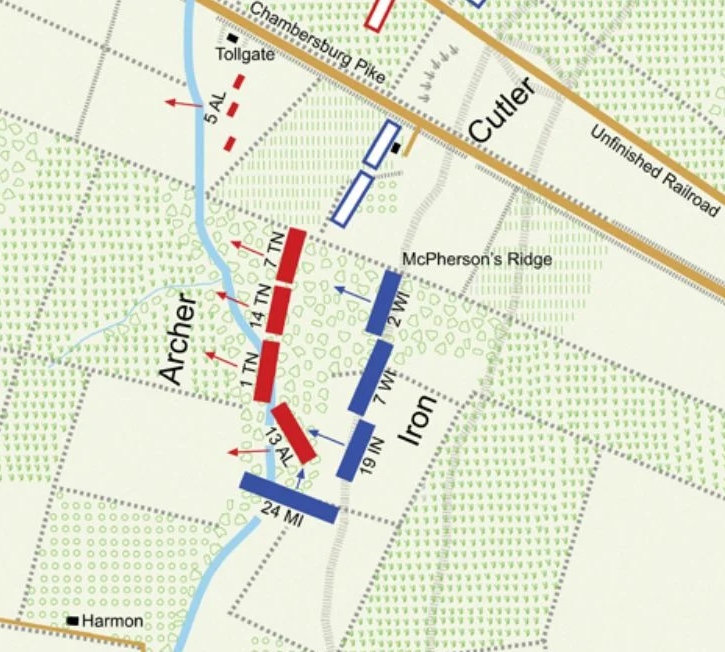
Like much else in the “official” history of the Civil War, that map of the opening engagement at Gettysburg — east of Willoughby Run, on the slope of McPherson Ridge — may not be completely accurate.
One of my pet peeves about how Gettysburg has been depicted is the portrayal of Buford’s Union cavalry as having fought some kind of desperate battle in delaying Maj. Gen Harry Heth‘s Confederate division in its advance from Cashtown that morning. Having spent quite a deal of time researching this subject, including personal observation of the terrain, I assert without qualification that the Union cavalry did little or no damage to the advancing Confederates. Once the first shots were fired by Buford’s advance vedettes (an honor claimed by Lt. Marcellus Jones, 8th Illinois Cavalry), east of Marsh Creek, what happened was this: Confederate Brig. Gen. J.J. Archer, commanding the lead brigade of Heth’s division, deployed the 5th Alabama Infantry Battalion as skirmishers, to protect the column marching behind them from any further harassment by the Yankee cavalry. The eastward march on the Chambersburg Pike then continued for more than a mile until reaching the crest of Herr Ridge. At that point, the advance halted, having come under fire by Buford’s troopers deployed on the other side of Willoughby Run, about 400 yards to the east of the ridge. Buford was supported by a battery of artillery (commanded by 21-year-old Lt. J.H. Calef), which opened fire as Heth and his officers were reconnoitering the position.
Heth deployed Archer’s brigade to the south of the road (which is now U.S. Highway 30) and deployed the brigade of Brig. Gen. Joseph R. Davis to the north side, with the artillery battery of Maj. William J. Pegram in the center. Meanwhile, on the Union side, Maj. General John F. Reynolds arrived on the field, riding in advance of the army’s First Corps. Reynolds consulted briefly with Buford, and quickly sent a note to the army commander, Maj. Gen. George Meade, promising to fight the Rebels “inch by inch.” As Reynolds’ infantry approached, they heard the firing and marched faster, the head of the column being what was to become known as the Iron Brigade. Reynolds directed them toward Willoughby Run, south of the Chambersburg Pike, while sending the next brigade, under Brig. Gen. Lysander Cutler, to the north side of the road.
Before these Union troops could reach their assigned position, however, Heth had finished his reconnaissance and, his two lead brigades now formed into line of battle near the crest of Herr Ridge, ordered them to advance eastward. This detailed narrative I relate as contradiction of the way these events have been depicted by “official” accounts of the first day’s battle at Gettysburg, with Buford’s cavalry heroically holding off the Confederates. All that the Union cavalry had done was to (a) force Archer to halt long enough to deploy a battalion of skirmishers and (b) to put up a sufficient show of force at Willoughby Run to compel Heth to deploy a full infantry battle line. If the Confederates had been completely unopposed in their march toward Gettysburg, they would have crossed Willoughby Run before 9 a.m. As it was, by the time Heth ordered his battle line to advance, it was around 10 a.m. No doubt, the Yankee troopers on the other side of the stream were firing their carbines at any target they could see, but so far as is known, during the whole of this engagement they neither suffered any casualties themselves nor inflicted any on the Rebels. Packed away in my garage is a notebook in which I have a copy of Col. Birkett Davenport Fry‘s account of Gettysburg. Fry commanded the 13th Alabama in Archer’s brigade, and nowhere in his account of the fight on July 1 does he suggest that their advance from Cashtown was seriously impeded by Buford’s cavalry.
Having vented about my pet peeve, then, I then recount what happened to my great-grandfather, Winston Wood Bolt, who was a private in Company K of Fry’s 13th Alabama. Most historians have the 13th Alabama as the right flank regiment of Archer’s brigade as they advanced from Herr Ridge, down a slight slope to Willoughby Run, and then up into the woods toward McPherson Ridge on the other side. About this time, on the Union side, the first elements of the Iron Brigade were reaching the field. Near the Chambersburg Pike, Reynolds was supervising the deployment of two regiments (the 2nd and 7th Wisconsin) from the Iron Brigade when he was shot dead. Some historians have attributed Reynolds’ death to a Confederate “sharpshooter,” but it was most likely just regular volley fire from the nearest troops of Archer’s brigade, probably the 7th Tennessee Regiment.
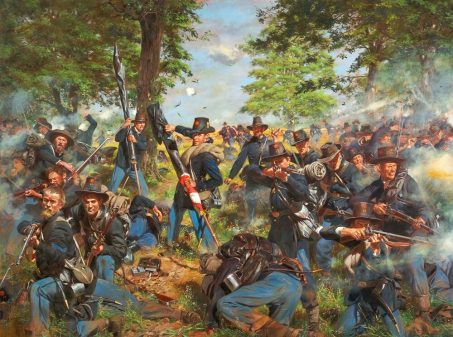
The Iron Brigade in action at Gettysburg
Any visitor to Gettysburg who takes time to walk over this part of the battlefield (as I have) will perceive that Willoughby Run crosses the road almost diagonally, so that the left side of Archer’s brigade probably crossed ahead of the right flank and, most likely, the alignment got disrupted. The first Union forces to reach the field were up by the road, and the 13th Alabama curled around facing toward the northeast — and then disaster struck. The last regiment of the Iron Brigade to arrive (the 24th Michigan, which had been bringing up the rear of the column) came over McPherson Ridge to the southeast, completely outflanking the 13th Alabama. The Confederate line was then rolled up from right to left, resulting in the capture of Archer and about 100 of his men, including my ancestor, Pvt. Bolt, who spent the next two years as a prisoner of war.
After being captured at Gettysburg, Pvt. Winston Wood Bolt survived two years at Fort Delaware as a prisoner of war. Here he is (seated, center) with his family circa 1900. My grandmother, then about 16, is at far right. pic.twitter.com/2MPcvrnL2f
— The Patriarch Tree (@PatriarchTree) July 1, 2026
Having a personal connection to historic events inspires a deep concern for the preservation of our national heritage, which it seems some of my fellow citizens do not share. But why drag John Roberts into this, huh?



![WHAT POLICY? Crockett Trips Through MS NOW Softball Question on Her Agenda if Elected to Senate [WATCH]](https://teamredvictory.com/wp-content/uploads/2025/12/WHAT-POLICY-Crockett-Trips-Through-MS-NOW-Softball-Question-on-350x250.png)